slideyfoot.com | bjj resources

 Home
 Contact
 Reviews
 BJJ FAQ  Academy

This website is about Brazilian jiu jitsu (BJJ). I'm a black belt who started in 2006, teaching and training at Artemis BJJ in Bristol, UK. All content ©Can Sönmez

31 March 2009

31/03/2009 - BJJ (Beginner)

Class #214


Roger Gracie Academy Kilburn (BJJ), Jude Samuel, London, UK - 31/03/2009 - Beginner

Fellow UK blogger Jadon announced a great idea for a trip: travelling to every BJJ club in the country (so if you're a club owner in the UK, would be cool if you could help him out). He's dubbing it 'The Great BJJ Pilgrimage', meaning you'll know what to look for if he ever releases a book.

It is something I'm sure most of us would love to do, including me. I'd head for the US rather than the UK: once I finally get myself a job and feel financially secure again, I'm planning to get some training in around California. The history of international BJJ starts there, so I'd enjoy taking a look at the Gracie Museum, then somewhere like Hollywood BJJ.

Admittedly, it also interests me because going by my blog stats, I get the most US hits from California, followed by New York and Texas, so would be especially cool to roll with anyone who reads this. It will only be brief (week or two), and certainly not going to be checking out every club. Maybe three or four at most, depending on how much sweaty man-rolling action my gf lets me get away with. ;p

I'm glad to see that my map is proving of use: once the Pilgrimage gets started, I'll stick in links on the map to Jadon's blog posts for each club. If I can work it out, would be nice to get some kind of 'follow Jadon' thing going: will have a play when he starts it.

Tonight's class followed on directly from yesterday. Jude kicked off with a turnover from turtle he showed the white belts yesterday (higher belts were told to drill something else, so I didn't have a chance to try it until today). Lapel choke again: arms straighten. You start on the side of their turtle, knee up behind and other knee in close to their near side, to stop them rolling out. Grab their gi lapel on the near side and yank it loose, then feed that through to your other hand. Make sure that as you do that, you don't reach your other hand in underneath their body: otherwise, they can overhook it and roll into a dominant position.

Once you've secured a grip on the gi, you'll now have a useful handle strapped across their waist. Grab their near-side elbow, then step your rear leg over to the far side. Roll them back towards the near side, get your hooks in, and move to rear mount. From here, rear naked choke.

After we'd gone through the lapel choke again, time for guard passage. I went with Rich, who is becoming a regular training partner (mainly because he's one of the few other blues at Kilburn, and therefore much less of an injury risk). Yet again I tried the star sweep off the handstand sweep, and yet again I got armbarred for my trouble. Still not staying tight enough, and I think I'm also rushing it, which means its sufficiently sloppy that my arm is left ripe for the bending.

On top, I'm continuing to force myself to stand up. Keep getting swept shortly afterwards, but then I'm never going to get it unless I work through that significant obstacle first. The problem is to do with my legs getting hooked, as is so often the difficulty with standing in guard. If I don't put my leg forward, its tough to stand up, but if I do, its easy to hook and initiate a sweep. Ideally I'd grab the sleeve on that side so I remove to risk of getting my leg hooked, but I've been finding it tough to secure the arm so far. Practice makes perfect, as ever.

Much the same thing with my next partner, another blue belt. I also still need to work on recovering closed guard from half guard, where the problem this time is getting a grip on the sleeve and opposite knee, then my foot under their trapped knee with the other foot pressing on their calf. I should also be mixing that up with some other options, like maybe the old school, along with my favoured functional half guard from Indrek Reiland.

In sparring with the same two partners, similar problems with half-guard, and I also need to watch for chokes from mount. I had thought Rich was going for a normal cross choke, which would mean when I rolled to guard, defending would be fairly straightforward: posture, squish elbows together, strip top arm away. However, it was actually an ezequiel, which meant that rolling to guard didn't help at all, as he already had it locked on.

Class is only an hour on Tuesdays and Thursday, so that wrapped up things for tonight. Should be training again on Wednesday: I plan to continue three times a week until I get my average back up to at least twice a week, as per my very geeky spreadsheet (the offline version is even geekier than the one I have up on Google Docs, which doesn't quite get to that level of detail).

30 March 2009

30/03/2009 - BJJ (Beginner)

Class #213


Roger Gracie Academy Kilburn (BJJ), Jude Samuel, London, UK - 30/03/2009 - Beginner

I had an interesting chat with Bryan Hogeveen this weekend, a name Fightworks Podcast listeners might recognise from his interview a while back. If you missed that episode, Bryan is an academic currently conducting a BJJ study, for which he's asking people to fill in a survey (one for women and one for men).

Bryan is also looking to interview those who are willing to give a bit more time. I love talking about BJJ, so I was happy to get the chance to babble at length (like I mentioned during the conversation, this is ideal for bloggers, who are always looking to share their thoughts about BJJ anyway). It doesn't matter if you're nowhere near Canada, where Bryan is based, as he'll phone you from his university. It sounds like a great project, so definitely deserving of your support: for further details, check out Bryan's blog.

On a different topic, it looks as if Eddie Bravo is gearing up to follow in the Gracie Academy's footsteps, with his own version of online training, complete with the ability to gain rank through video. It should make for a revealing comparison with the Gracie University: I'm particularly intrigued as to whether or not Bravo manages to avoid the criticism Gracie University has received (which I listed back here). I've long thought that the Gracie Academy and Bravo have a lot in common, given that they both rely on sometimes controversial marketing to maintain their reputation, rather than major current competitive success (as opposed to, say, Gracie Barra with Roger Gracie, Alliance with Cobrinha or Gracie Humaitá with Xande Ribeiro, to cite just a few examples from those powerhouse teams).

Also, just noticed as I was writing this that Oli G, the undisputed king of competing at every competition ever, has set up a swish looking new site to showcase his competition videos. Check it out here.

Jude focused on chokes for tonight's session. First the basic rear naked choke. Put your arm around their neck, pressing the bony part of your forearm into their throat. Grab the bicep of your other arm, making sure not to bring the bicep arm out straight (otherwise they could potentially grip your wrist and submit you, using their shoulder to bend your arm the wrong way). Finally, the hand of the bicep arm goes to the back of their head, then you squeeze their neck between your two arms.

The RNC was followed by a lapel choke. From rear mount, reach over their shoulder and grab deep in their collar. Your other hand comes under their armpit and grabs the other collar. To finish, straighten out your arms, pushing forward and thereby squeezing your partner's neck between their lapels.

Finally, Jude went through the clock choke. This is similar to the lapel choke, except that it is applied when your partner is turtled up, and the execution is with your bodyweight rather than pulling on the collars. Once you have the grip on their lapels, drop your weight onto their neck, staying tight. In order to secure your base, put your forehead to the floor on the other side, then slowly walk round, one leg at a time, starting with the bottom leg. Your legs are acting as the hands of a clock, hence the name.

In guard passage, I kept trying the Saulo guard break without much success: still not controlling the hips well enough, which I think continues to be my main problem in somebody else's guard. I also tried standing guard breaks, getting to my feet while holding their sleeve, but need more work on establishing base and being careful with my legs, avoiding sweeps.

Underneath, I again attempted the combination of handstand sweep with star sweep. Swinging both legs to the same side works ok, but I'm not staying close enough to the leg. I need to knock them off balance by getting in tight to their thigh. At the moment, I'm leaving too much space, which is why last week I basically ended up under side control, while this week Rich caught me in a randomly positioned armbar.

Another thing I wanted to work today was replacing full guard from half guard. My aim was to grab their shoulder and leg, then get my same side leg under their knee, while the other foot trapped their calf. I'd then lift them up and drop them back into full guard. However, the problem was firstly getting that foot under their knee: can be awkward depending on how I've locked the half-guard. I'm also not getting a good grip on the arm, and when trying to grab onto the knee, my arm is too loose.

When sparring with one of the white belts, that meant I was sitting there working my way of an Americana from much of the spar. Fortunately for me, they didn't know how to finish it, but that's the only thing that meant I was able to avoid the submission. So much like last lesson, I was underneath a white belt in half-guard, though at least this time, I was working towards something specific.

It was good to see John there, who is a purple belt that weighs the same as me. I've sparred with him once before, back at RGA HQ: hopefully he'll be at Jude's regularly. He had lots of advice, such as trying Saulo's running escape under side control. I had thought that was only useful for when they had both arms on the near side of your body, but John mentioned that you could often direct their arm to where you wanted. Gave it a try in sparring and it worked ok, though obviously John was letting me have it (he took on an instructor role for everyone he sparred with: IIRC, though he's still a purple, he's been training for a looooong time).

Finished off class by buying myself one of the snazzy new RGA branded t-shirts. I've generally avoided buying stuff, given continuing lack of job, but as its almost my birthday, I thought I'd treat myself. :)

25 March 2009

25/03/2009 - BJJ (Beginner)

Class #212


Roger Gracie Academy Kilburn (BJJ), Jude Samuel, London, UK - 25/03/2009 - Beginner

Annoyingly came down with something last week, which meant I wasn't able to finally get into a regular pattern of BJJ as I'd hoped. 2009 in general has been pretty poor so far in terms of consistent grappling, but I'm aiming to train three times a week next month, so I get back to my preferred average of at least twice a week (yay for spreadsheets which make that easy to work out).

I read an excellent blog yesterday, called The Manly Odyssey. It is by a guy who trains with Pedro Bessa in Bristol, and in it he talks about a long trip he took through Asia. The reason this was so awesome is that he and his friend George did plenty of training on the way through, meaning this effectively becomes an improved version of The Last Wrestlers: no weird sexist theories about women, just lots of grappling and entertaining travel anecdotes.

Class tonight was on knee-on-belly, though things started with three rounds of guard passage. I started with one of the blue belts, and again tried to get into the habit of standing up to pass. Obviously didn't pass, but its getting more natural now to get onto my feet. Also spent lots of time in my usual passive position defending chokes, but hopefully I can gradually either steer into standing up, or somehow get better at passing on the knees (the latter is rather unlikely at the moment. Would be great to have a private lesson on it some time, so once I get a job, will probably try and do that).

With the white belts, things got more entertaining. As Jude's academy only opened this year, there are lots of absolute beginners. That meant I could work on my weaknesses, like submissions. I played around with the loop choke from Renzo's DVD a few times, where I think my problem is that I'm not getting enough gi material to pull across, and I'm also not managing to get it into the throat properly.

I also had a go at some of his triangle set-ups, which did get me in position, but then my foot kept cramping up when I tried to lock it in. Presumably a combination of bad technique and poor diet or something: I wasn't getting my shin sufficiently far back either. There was an opportunity to play with one of stranger options from Kukuk, which I think is a double armbar (starts by locking legs around their shoulders), but needless to say that didn't go anywhere.

Jude then demonstrated the kimura from knee on belly, which also brought up lots of useful tips on the position itself. First you need to get there: from side control, grab the back of their collar, your other hand on their hip. Press-up and drive your knee through, keeping the toes of that leg off the floor. You can now put pressure on your partner, by pulling up on their collar and their knee.

In order to give their stomach some relief, their natural reaction is to put their hands on your knee. As soon as they do that, push their hand to the floor and sprawl backwards. It is important here to keep your weight on them, so twist your hips and get into a diagonal position on their shoulder. Next, step the leg nearest their head over, bringing your foot to their face.

As my partner said, this is the essential part: concentrate on getting that heavy pressure, rather than focusing on the submission and thereby losing your positional control. Once you've got them trapped underneath you, apply the kimura by twisting their arm and slightly raising their body up.

If they manage to resist the kimura by grabbing onto their belt or gi, you can change your position to still land the submission. Maintaining your kimura grip, twist your body and pull them up, bringing your legs around their head as you do so. That will mean you are now sitting on their head with your feet crossed underneath it.

Now you're ready to break their grip. Keeping their arm tight to your chest, release the hold you have on your own wrist and instead grasp your own collar (you're still be controlling their arm with your forearm). To weaken their hold, turn their wrist clockwise, using the hand holding their wrist as well as brining your forearm up. With their wrist turned, they will only be able to hold on with a finger and thumb rather than their whole fist, meaning that you can now pull the arm free and push their wrist down and to the side for the tap.

Once we got to sparring, I was with a typically eager white belt. Almost the whole time, I was lying under half guard, where I so frequently end up. The recurring problem is that I tend to have my head on one side and my legs on the other. That limits my technique, as the only sweep I know (the basic 'pull their arm over' from here) requires your head to be on the same side as the trapped leg, as would taking their back. I'm still looking to recover guard from here as my first option, so need to review the technique for that.

It is a bit pointless just flopping around in their half guard, so I tried giving my partner mount. Almost immediately ended up back in half guard. Next time I find myself in that situation, I think I'll need to make a conscious effort to completely avoid using half guard, and instead focus on the bridge and roll from under mount, or wedge myself under side control so I can work escapes from there.

Next week should be three sessions, but that depends on if I manage to stay healthy. My niece has come down with conjunctivitis, which is contagious, so not sure if I'll be able to avoid it (trying to just wash my hands a lot, but I've read the bacteria is airborne, so that may not help much. But hey, at least I'll have really clean hands).

24 March 2009

DVD Review - Renzo Gracie/Craig Kukuk Brazilian Jiu Jitsu Instructional Videos

Short Review: Renzo Gracie and Craig Kukuk produced an excellent instructional back in 1994, which has managed to stay fairly relevant despite its venerable age. The teaching is great, made even more accomplished by coupling it with vale tudo footage, showing you the application under pressure. It is also generally cheap, which is very worth it considering you get five hours of instruction. One thing to keep in mind is that this does look dated when it comes to guard passing and takedowns: that last forty minutes should be taken with a very large pinch of salt.

Full Review: Rorion and Royce were the first to release an instructional video series on Brazilian jiu jitsu, but Gracie Jiu Jitsu Basics would be eclipsed three years later in 1994, when Rorion's cousin Renzo released a far more comprehensive set. Helping him was Craig Kukuk, most notable for being the first American to gain a black belt in BJJ. Initially, Kukuk was counted among the black belts from the Gracie Academy in Torrance, though he physically received his black belt from Royler in Brazil. However, there was later a falling out between Kukuk and Rorion (this thread from 1995 claimed it was due to Rorion's sudden raising of affiliate fees, while this alleges it was due to Rorion holding back techniques), leading Kukuk to eventually become a part of Renzo's school in New York.

Their new instructional considerably expanded the limits set by Gracie Jiu Jitsu Basics. Whereas Rorion's set consisted of three tapes along with a bonus, Renzo and Kukuk packed in eleven (on the DVD, those are spread across three discs). Not only was their series much longer than Rorion's, at around five hours, but it contained much more material per tape. Renzo and Kukuk also managed to bring in some progression, with videos covering what they called both "beginning" and "advanced" armlocks and chokes respectively.

Unfortunately, according to the internet rumour mill (e.g., this and this), Kukuk and Renzo fell out after this video proved successful. Allegedly, Kukuk made much more money than Renzo, instead of dividing profits equally (it should be noted that this post suggests Renzo may have accused Kukuk unfairly). The relationship rapidly broke down, to the extent that some have even claimed Kukuk tried to get Renzo deported. Whether or not that is true, Kukuk went on to release another large instructional in 1999, Brazilian Jiu Jitsu: A to Z and currently teaches in Boise, Idaho. The rights for the series he made with Renzo were apparently bought by Paul Viele, who released a DVD version in 2003.

None of that detracts from the high quality of the impressive eleven tape series Kukuk and Renzo delivered in 1994. They both provide solid instruction, with teaching duties switching between the two at various points, running through each technique two or three times. Each time you get two or more angles, then a repeat at full speed, again from several angles. Having a native English speaker was something new for BJJ videos, further emphasising the clarity of instruction (though Renzo's English is perfectly acceptable).

Like Renzo's later book, BJJ: Theory & Technique, organisation is a slight problem. The DVD set isn't anything like as arbitrary as the book, but putting armlocks before escapes makes little sense, as does leaving guard passing until late in the series. Of course, it is easy enough to just watch the tapes out of sequence (I'd suggest a beginner should start with the escapes from side control and mount on tapes three and six), and it is also much less of a problem if you've already got some understanding of the fundamentals.

The first tape, Beginning Armlocks, covers the Americana, kimura and armbar from several positions over roughly twenty-seven minutes. Helpfully, Renzo and Kukuk also link the moves together: for example, if your opponent manages to block your attempt at an Americana from side control, Renzo and Kukuk demonstrate how you can attack the other arm with an armbar. Important details are emphasised along the way, such as keeping the arm tight to your chest when applying the kimura from guard.

Advanced Armlocks (slightly over thirty minutes) is unsurprisingly more complex, with numerous techniques, many of which involve pressing the back of the elbow rather than the usual hyperextension in the other direction. The armbar from scarf hold looks useful, as previously the only submission I've ever tried from there is the step-over triangle. Then there are techniques like the Americana with the legs Renzo demonstrates, or Kukuk's armbar which begins by locking both legs around your partner's shoulders from guard.

Escapes from the Bottom comes next (around forty five minutes, but almost half of that isn't instructional): specifically, these are escapes from side control. Other instructionals I've watched tend to prefer arm positioning where you press the forearm either into the neck (as on Roy Dean and Saulo Ribeiro), or swimming through to reach under the armpit (which is Rorion's choice on Gracie Jiu Jitsu Intermediate). Renzo shows both, explaining that the position of your opponent's arms will determine where you put yours (if they wrap behind your head, your forearm goes into their throat; if both arms are on the one side, your arm drives under their armpit). Renzo also adds in something extra, demonstrating how you can escape straight into an armbar instead of just shrimping back to guard.

Another innovation Renzo and Kukuk bring to their instructional is the inclusion of fight footage to illustrate the application of a technique. These are normally vale tudo fights from Brazil, with a voiceover from Kukuk explaining the relevance. Often it is just a short clip, but there are also extended sequences: the third tape features probably the longest, with around twenty minutes of no holds barred competition exemplifying how to avoid getting mounted.

The fourth tape (which kicks off the second disc of the DVD version), Escape from the Headlock, didn't particularly grab my interest over its twenty-five minutes, as it isn't a position I often find myself in. Like Rorion's approach in his headlock tape from Gracie Jiu Jitsu Basics, this segment is from a self-defence perspective, something Renzo and Kukuk never entirely forget throughout their instruction.

Eight minutes are devoted to escaping a standing headlock, with another four on the standing guillotine: neither are very likely in a BJJ competition, but it makes a certain amount of sense when training for the street. Again like Rorion, the headlock on the ground has some relevance to scarf hold, but unlike Rorion, Renzo does actually demonstrate proper scarf hold as well (i.e., controlling the arm as well as the head).

By tape five, Renzo and Kukuk have reached the guard, which again is roughly twenty five minutes. As with headlocks, self-defence remains a major concern, with advice on maintaining a defensive posture against punches by either keeping your attacker far away or in close (depending on whether they've got close enough to hit you or not). Avoiding getting strangled in your guard is covered too: while only a total beginner would try this, it is nevertheless useful to include the defence, which I've never seen taught in class (presumably because it is such a noob thing to do).

Basic sweeps are explained too, starting with traditional techniques like the double ankle grab sweep, along with fundamentals like the scissor and flower sweep. Kukuk also demonstrates one I'd forgotten about, where you lock your legs around their upper thighs, pull their sleeves across your body, then roll them over to the other side. In a voiceover to some tournament footage, Kukuk then makes the important point that you shouldn't try to hold closed guard on the street when somebody stands up, as you're liable to get slammed.

Defend the Mount comes up next, which should have been right at the start of the set: once more, its about twenty five minutes. Like their side control tape, Renzo and Kukuk stick with the basics, focusing on the upa and the elbow escape (which I tend to refer to as shrimp escape, but it is normally called the elbow escape because you use your elbows to press on your opponent knees when making space to recover your guard).

Bizarrely, Kukuk begins by saying how you should lie with your legs "stiff as a board" at the opening of the video, so that your opponent can't hook them. I guess this is geared towards a street fight or something (although I'm still not clear how that straight-leg position is a good idea), as when demonstrating technique later on, he keeps his knees up in the normal way.

The second disc finishes with what was the seventh tape, Beginning Chokes (about twenty six minutes). Renzo starts things off by taking you through the mechanics of a rear naked choke: Kukuk kneels in front of him to make this as clear as possible. Renzo moves on to the application, getting his hooks in, and also how to stretch your opponent out if you have their back and they roll to their stomach. To finish, there are some examples of the choke in action during some vale tudo.

This is a perfect example of how techniques should be taught: introduce the concept, show the application, then provide some evidence with it working against resistance. Renzo's presentation is sufficiently concise that it is still barely over three minutes, but with a decent level of detail nonetheless.

Cross chokes from mount and various gi chokes in the guard follow. The self defence element is still present, with Kukuk pointing out how to protect yourself from headbutts and strikes when attempting a choke, and as ever there is plenty of solid technique.

The cross choke from guard was strangely absent, but perhaps Renzo decided that it was similar enough to the version from mount that it was effectively duplication. Though I think the tape suffers for its omission, there certainly is no shortage of other techniques. In particular, I liked the look of a gi choke where you grab the middle of their collar and pull them down, wrap your other arm around their head, then feed the gi to your wrapping arm. To secure the choke, drop your elbow to the mat and raise your hips.

Twenty-four minutes of Advanced Chokes on tape eight (or disc three, for the DVD) interestingly begins with the triangle choke from guard, which most BJJers would probably see as a basic technique. As with his explanation of the rear naked choke, Renzo really shines here, in what is possibly the highlight of the whole series. The reason it stands out is because Renzo first demonstrates how the triangle works, then shows several set-ups. Many instructionals have techniques in isolation, but only rarely do they tell you how to actually get into position to apply the technique. Like before, you also get to see the triangle used by Renzo himself in a vale tudo match.

Kukuk is responsible for laying out the papercutter choke from side control, also seen on Rorion's Gracie Jiu Jitsu Intermediate two years later. Usefully, Renzo notes how there are several chokes you can begin in mount but finish in guard, if your opponent tries to roll out to escape.

The next tape spends around twenty-eight minutes on the mount. However, this isn't what you might expect, as submissions from the mount have already been covered in earlier tapes. Instead, Kukuk and Renzo take a thorough look at maintaining the mount position, along with its self-defence implications. Like Rorion, Kukuk shows how you can be punched when mounted, but can't effectively punch back. Fundamental tips like swimming with the arms and stripping their hands off your knee are carefully explained, along with what to do if they try to push on your pelvis.

I especially liked the way that real footage is then used to prove a point. Kukuk's voiceover of a Ryan Gracie fight puts it particularly well:

If asked about the mount and how to escape, a lot of experienced fighters will tell you they'd just gouge or bite their way out. They say this because they don't know the way out. You must remember, when you're mounted, you're in control.

In this fight, the man on the bottom is accused of some dirty tactics, so the man on the top bites the lobe of his ear off, and there is nothing he can do about it.


After even more advice on maintaining the mount, the tape finishes with around ten minutes of some other vale tudo matches to really drive the point home. It is a shame that the countless multitude (e.g., this letter from Black Belt) of traditional martial artists clinging to the 'deadly eye gouge' as some kind of magic weapon against grappling weren't forced to watch Ryan's definitive answer.

The two final tapes, covering passing the guard and takedowns, remind the viewer that despite its many strengths, this tape is over fifteen years old. Fortunately, these are also the two shortest tapes, neither making it past twenty minutes.

The first glaring example is when the infamous Gracie Gift rears its much-triangled head once again. Renzo and Kukuk run through the technique in a fairly similar fashion to Gracie Jiu Jitsu Basics. Like Rorion, Renzo extends his arm straight out to hold his opponent's bicep, and like Rorion, helpfully lifts a leg onto his shoulder so he can easily be locked into a triangle. There are also a few more details, like when Renzo shows how you can dig yourself into even deeper trouble by grabbing onto your leg.

This penultimate tape isn't all bad, however. Renzo also demonstrates the cartwheel pass, which while rather acrobatic is at least not guaranteed to put you in serious danger of getting choked. Renzo also spends some time on my favourite, pinning the leg, although the big problem there is getting the guard open in the first place. Kukuk has an answer for that, demonstrating a break from standing where you drive your knee through, dropping the opponent down so that you're able to wedge your knee in to make space.

Self-defence closes the tape, where Renzo and Kukuk show three more options for opening the guard, all of them unpleasant. First, the can opener, where you grab behind their head and pull it towards you, creating pressure on their neck. Second, and even less sporting, slamming anyone foolish enough to keep their guard closed when you stand up in a street fight (obviously you don't slam in competition). Finally, Kukuk uses a choke from inside the guard to open up the legs, though as seen in the earlier beginning and advanced choke tapes, this is liable to get you armbarred.

The last tape, covering takedowns, is definitely the worst. When I was looking around for reviews, I thought that one was totally out of line for stating that "Craig Kukuk looks like a complete idiot (he moves like one too), and some of the things he covers will get you killed. God forbid you should try some of these moves in a real fight or BJJ tournament." While I think that's an entirely incorrect appraisal of the DVD set, if he had only watched the takedown tape, I could understand why they might jump to that conclusion.

Neither Kukuk nor Renzo look confident when shooting in for the takedown, and the shots themselves are stiff, too high and very telegraphed. Although I'm not a wrestler and I suck at takedowns myself, even I could see that these were low quality. However, in their defence, there is then an extended sequence of fight footage where the takedowns are shown in action and working. I doubt very much that would be the case today given the vastly improved competition, but in context, the first part of the tape makes a little more sense.

Once Kukuk and Renzo reach the clinch, its standard fare, quite similar to Rorion's tape on the same topic. Renzo also shows you how to correctly pull guard, by first putting your foot up onto their hip to get them to bend at the waist. Renzo's demonstration of a technical stand-up is also reasonable enough, again with real footage to show how to apply it.

As with most BJJ instructionals, including more recent releases, I wouldn't recommend them if you're looking to get great takedowns. Invest in a wrestling or judo DVD instead, as they are far, far better at throwing people to the ground.

Aside from the last forty minutes, the Renzo Gracie/Craig Kukuk set is an excellent instructional, which still mostly holds up today despite its considerable age. The teaching is great, made even more accomplished by coupling it with vale tudo footage. It is also often available cheaply.

If you are a beginner, then take the last two tapes with a very large pinch of salt, and I'd also strongly recommend you watch the videos on escapes (Escapes from the Bottom and Defend the Mount) first, rather than viewing in tape order. Alternately, buy Blue Belt Requirements first, then after you've got a good understanding of the fundamentals, move on to Renzo and Kukuk (though I'd recommend Cesar Gracie as a better next step after Dean's DVD). That will enable you to review your basics, and also provide useful progression: loads of techniques to play with, which at the same time aren't too complicated.

21 March 2009

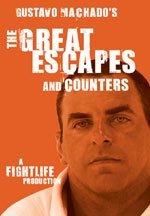
DVD Review - The Great Escapes and Counters (Gustavo Machado)

Many instructionals take submissions as their focus. After all, that is what a lot of people find most exciting in BJJ: getting the tap in the most unorthodox and flashy method possible. Submissions are of course important, as from a competitive perspective, successfully applying a submission will instantly win the match, no matter how many points you may be down.

Offence is all well and good, but in order to have an effective offence, you need great defence. If you're confident that you can get out of bad positions, then that will make your attacks all the more dynamic: solid defensive skills enable you to take more risks.

This is where Gustavo Machado comes in, with his 2006 release, The Great Escapes and Counters. Over the course of around two hours, Machado demonstrates how to deal with the most common attacks and positions in Brazilian jiu jitsu. The DVD is split into thirty-six sections, though in some of those several variations are covered, so it ends up being over forty different techniques. That makes for a fairly comprehensive selection, comprising of the cross choke, ezequiel, Americana, Kimura, armbar, triangle, omoplata, guillotine, crucifix, rear naked choke, bicep slicer, arm triangle, anaconda, Brabo, ankle lock, side control choke and baseball bat choke, along with positional escapes from side control, scarf hold, north-south, cradle, knee-on-belly and mount.

Generally Machado spends around three minutes on each technique, starting by briefly showing the submission itself, then walking you through the escape from two angles, and finally showing it full speed. Though most of the demonstrations are around the three minute mark, it does vary, and on top of that, with some submissions Machado splits each escape into a different section.

For example, Machado shows four different options for getting out of the triangle choke, each one in a separate segment of between two to four minutes. By contrast, he tackles the armbar from mount in one five minute chunk, covering three variations. Normally Machado will also cover a submission escape from several positions, like the kimura from top and bottom half guard, along with closed guard and side control. That obviously depends on the versatility of the submission: escaping the rear naked choke is only shown from the back mount, as you'd expect.

The explanations are reasonably clear: Machado speaks good English and is obviously a competent teacher with an eye for detail. This is further helped by the camerawork, which zooms in and out to pick up on fine points. Importantly (though this might seem trivial), Machado's training partner Tinguinha (who has his own range of DVDs out on the same label) is wearing a blue gi. There are a lot of instructional which are definitely hindered by both people wearing the same colour gi. Having one with a white and one with a blue (or just anything that isn't white) gi is a small point, but it greatly helps to reduce confusion when limbs are getting all bundled together.

All in all, this DVD makes for an excellent reference tool if you keep finding yourself getting caught in certain submissions. It isn't a bad purchase for beginners, as it does cover the basics, but there isn't enough coverage of things like side control and mount escapes for somebody new to the sport. As ever, Blue Belt Requirements is still the first DVD I'd recommend to anyone starting out in BJJ, but Machado's DVD is a good later purchase. You can buy it as a download from the publisher, Fightlife, over at their site for $39.95, or as a DVD (both formats are the same price).

16 March 2009

16/03/2009 - BJJ (RGA Kilburn)

Class #211


Roger Gracie Academy Kilburn (BJJ), Jude Samuel, London, UK - 16/03/2009 - Beginner

As of this week, I'm finally getting back to regular training at a proper BJJ school. I haven't been on the mats for a while, so plenty of stuff to talk about since January.

To start with more mundane matters, I'm still job hunting (if anyone knows of anybody around Coventry or Birmingham who could use somebody with four years experience number-crunching in Excel, let me know), but on the writing side of things, its been a lot more positive. That is largely thanks to Dolph: I've been looking for a particular text for ages, which Dolph was able to resolve with one email. Very awesome. That kick-started my research, which had been languishing a bit recently, so I've been delving into the history and context of AIDS.

Most recently, Randy Shilts' And The Band Played On has been an excellent and informative read, though I'll of course need to check through lots of other sources before I can get a true picture of the period. US Government archives have been handy for corroborating some of what Shilts' mentions, like the shocking lack of official action on AIDS during the 1980s, both in terms of policy and budget, by the Reagan administration.

In terms of BJJ, there has been some big news this month. The Gracie Academy, where it all started, has now taken a step further than its already controversial Gracie Combatives program. Previously, you were able to test for a 'combatives blue belt' after completing the 36 lesson syllabus. That brought up the possibility of people with only a few months (or even weeks, with intensive courses) training being able to claim they were qualified to teach (whether or not they would make the distinction between Gracie Combatives and Brazilian Jiu Jitsu was an especially important issue).

The Gracie Academy's argument was that a Gracie Combatives blue belt was not the same as a BJJ blue belt: Rener, Ryron and Rorion have been making an increasing distinction between self defence orientated Gracie jiu jitsu and the 'sport' jiu jitsu of other BJJ schools. The new Gracie University (also available on DVD) does a whole lot more. Not only is it now possible to get blue, purple, brown and even black belts in Gracie Combatives, but you can both learn and test for those belts through video submission.

Needless to say, that's been all over the net: EFN, NHBGear, Sherdog, The Underground etc. I go into more detail on my own opinion in the Bullshido thread, here. Note the similarity to the earlier debate about Gracie Combatives: Sherdog, NHBGear, Bullshido and EFN.

I'll be reviewing developments with interest: from what I can tell (e.g., there's a free sample showing the kimura), Rener and Ryron's level of instruction is excellent. Also, the Gracie Combatives DVD set itself is comparatively reasonably priced, at $119 for 13 DVDs and over 18 hours of instruction. By comparison, Saulo Ribeiro's excellent Jiu Jitsu Revolution commonly retails for around $150, getting you 6 DVDs and slightly less than 6 hours of instruction.

The controversial part, the online grading, is where the cost begins to add up. On top of the learning material ($144 for online or $119 for the aforementioned DVDs), to test costs $85, and there are then four stripes per level. Still, it does apparently stay at $85 for testing, judging by the response on the GU forum (which is in a pure question and answer format, rather than the normal bulletin board set-up). The big question is whether or not you can really evaluate somebody's jiu-jitsu purely through video, without having observed the student for a long period of training month in, month out.

As to the BJJ class I attended tonight (I'll type up a fuller review of the facilities, environment etc a bit later), techniques stayed fairly basic, as it is mostly white belts. That is one of the best things about this class: I'm really enjoying the chance to work my fundamentals. Jude starts that right from the drilling, with standing up in guard, side control escapes and cross choke from the guard.

In the technical section, the focus today was the armbar from guard, followed by armbar from standing guard and finally armbar defence. Jude clarified a point I've wondered about in the past, which is crossing your feet when doing an armbar.

If they're in your guard on still on their knees, crossing your feet will put weight down their spine. That is to your disadvantage, as it will naturally lean their body in the wrong direction. Instead, you want to keep your feet uncrossed, so you can push down behind their neck. This will keep them off-balance in the direction you want, breaking their posture.

However, once they've stood up, it doesn't matter if you keep your feet crossed or uncrossed. What is important is that you drive your heels down whether or not your feet are crossed, to keep their arm trapped and prevent them pulling up to make space.

There was also a slightly more advanced technique, but Jude still managed to keep it relatively straightforward. For a basic spider guard pass, first step to the side, past their straightened leg. At the same time, bring your hand on top of their other leg, then drive that arm diagonally across and down.

You can now grip their straightened leg with one hand high, the other low by their inner thigh. Step the foot nearest their head next to their ribs. Yank their leg up, pushing your hips forward. Finally, drop into side control, replacing your blocking foot with a knee.

Sparring was guard passage, where as ever I wasn't too successful on top. However, I did at least manage to stand, which as I've been saying for ages, is a habit I need to get used to. Underneath I was a bit more active: the main thing I wanted to try was following up a handstand sweep with a star sweep. In short, the latter technique is swinging your leg around to the same side, roll to your knees, then pull up on their leg to drop them to the floor.

It sort of worked, but the problem I have is that I'm concerned about my training partner's knee when I do that. It looks as if I'm not careful, that could tweak their knee, so definitely need to watch it when practicing the star sweep. No point in doing a technique if its likely to cause injury.

Free sparring was as ever lots of escaping from side control and knee on belly. I keep forgetting to really bridge into them, like Saulo shows in his DVD set, so that's a habit I'm trying to build. Had a quick BJJ session with my gf last week, so hopefully we can make that a regular thing again. Only going through a quick warm-up at home, using techniques for drills, but still helpful to run through side control escape repeatedly.

My sister is away, so I'm probably not going to be able to make any other classes this week, as I need to be there to look after my niece (my brother-in-law came back early today, so I can get in some BJJ). Might try and do three lessons next week to make up for it, but depends on how quick my sister gets back from work.

11 March 2009

DVD Review - Renzo Gracie: Legacy

Brazilian jiu jitsu has rapidly spread across the world, and is now becoming a fashionable sport. While this has the disadvantage of some dubious individuals seeking to take advantage of demand for BJJ, it also means that excellent documentaries like Renzo Gracie: Legacy can find a sizable audience. I had heard about Gethin Aldous' film from various internet sources, so jumped at the chance to pre-order it last year. It finally arrived in late December, when I watched it with my younger brother.

That says something about its appeal: my brother has never done any martial arts, or shown any interest beyond the odd action flick. However, he was riveted to this film, so it isn't just for those already heavily involved in the sport. Renzo is well-known for his abundant charisma, which is on full display: despite several long periods which simply show Renzo talking in his car, his personality is such that you're drawn into his stories.

One of those stories surprised me, when Renzo talked about his father Robson. I've read The Gracie Way and a whole bunch of other sources for my BJJ history, but I had no idea what Robson had gone through. Renzo relates how his father suffered torture for his opposition during the military junta in Brazil, only escaping death through the political connections of a student.

There is a general sense of being part of the Gracie family, with numerous members featured throughout the film (if I remember correctly, that includes Ralph, Renzo, Rickson, Relson, Roger, Kyra, Robson, Ryan, Daniel, Rodrigo and Royler.) You get to see Renzo with his children, talking to his relatives about the past, and training with brothers, cousins and uncles in preparation for fighting.

It is fighting that forms the centrepiece of the documentary. The film begins with Renzo's classic knockout of Oleg Taktarov, and features numerous quotations from Renzo himself about the importance fighting holds for him. At one point he shows surprise at how many fighters seem to compete for the money: Renzo just loves the challenge.

There wasn't as much of a focus on history as I would have liked, with a large chunk of the fights coming from the latter part of Renzo's career. However, that does make for an interesting trajectory, as it isn't simply Renzo crushing the opposition. Instead, we get to see him overcome adversity, bouncing back from defeat to again prove his skill in the IFL against fellow veterans.

Like The Smashing Machine, the film provides the viewer with an insight into the whole process of a mixed martial arts fight. The camera follows Renzo through his training, overcoming injuries, travelling, exploring the venue, then finally the fight itself along with its aftermath. We also see how Renzo trains others in his family, in particular the powerfully built Daniel Gracie. The inclusion in the film of this younger Gracie provides an opportunity to present a picture of Renzo the teacher as well as Renzo the fighter.

It is a good documentary, but what puts this above The Smashing Machine for me is not the main feature, but the impressive selection of extras included on the DVD. As opposed to the brief snippets offered up by some DVDs, these extras are almost all huge. They are also distinct from the film in that the extras seem very much geared towards hardcore fans rather than a general audience.

For example, there is an extensive conversation between Renzo and two of his black belts, Matt Serra and Ricardo Almeida. For the general public, this is probably very boring: a bunch of sweaty men talking about different strategies and specific techniques they feel are important to mixed martial arts competition. But for those who can empathise with sitting on the mat chatting about favourite moves, this is awesome. It also reflects well on Renzo's character: the teacher is more than willing to learn from his students.

You also get to see a sparring match between Maurição Motta Gomes and Renzo, from 1997. Seeing two masters fight is always a pleasure, although I have to admit a certain disappointment that we don’t get to hear the two men talk. I was looking forward to hearing a voice I know popping up, particularly as Maurição is every bit as charismatic as Renzo. His son Roger also appears, in an extra about the Abu Dhabi 2003, though again he is just in the background.

That desire to hear some extended chatting from the BJJ celebrities was later satisfied by yet another extra, in which Renzo talks to his uncle Relson Gracie. As you would expect from the man famous for being as tough on the streets as he is on the mats, this feature is awash with stories of Relson laying down the law in Brazil, and even on a football field in Hawaii.

Finally, there was another extra which I found intriguing, ‘Renzo and Roosevelt’. Renzo discusses the fight at the Whitehouse between Maeda’s teacher and the American wrestler, under the auspices of Teddy Roosevelt. Renzo claims that Maeda was ready to step up in the other man's place and could have won, but was not allowed due to being a rank below the other judoka. According to Renzo, Maeda was so annoyed that he decided to leave the judo association and “return to his roots, jiu jitsu”. I wasn’t certain if that was a classic case of BJJ dismissing the contribution of judo (which I always thought was something more common to Helio’s side of the family), or a story with some truth to it. If anyone has a link to some evidence, let me know.

All in all, this is without any doubt the best DVD documentary currently available for fans of BJJ. The piece on Renzo would have made this a good DVD well worth picking up, but the fantastic extras elevate this to an absolute must-have.

(Note that at present this is only available Region 1, but multi-region DVD players are fairly easy to come by now.)

04 March 2009

Gi Review - Black Eagle Judo Gi

I first tried a proper judo class in 2005, but got injured three sessions in, so it was long past time I gave it another try. That previous stint of training meant I already had a gi for my next attempt at judo in October 2008, but because I wanted to bring my gf down to class too, I'd need a second suit. Black Eagle offered their basic 'Adult Elite' judo gi for the fairly low price of £25, which seemed a good deal (especially as they were running a 10% discount promotion at the time).

Although I haven't trained as much judo as originally planned (largely due to a change in circumstances that means I'm not at Warwick Uni as much as before), I've had no problems with this gi in the judo sessions I've made it to so far. It hasn't shown any signs of wear and tear, and after a few washes and one 30 minute session in the spin-drier on high heat, it has shrunk sufficiently for comfort.

This gi felt a lot baggier than my other judo one, which is especially noticeable when I've worn it for BJJ, as that provides my training partners with more handles and makes it easier for them to secure a choke. On the other hand, just means I have to work harder on my defence, which is probably a good thing. It also enables me to use my own gi to attack, wrapping up their limbs, or at least it would if I had any idea how to do that properly. ;)

It is also fairly light and not too stiff. That means I often grab this when I want to bring a smaller gi, as the Black Eagle packs up tighter than my Padilla counterparts (especially the single weave). It didn't cost me very much, so I'd also be more likely to take this one traveling, as it wouldn't be as much of a hit to my wallet as if I lost a higher quality purchase.

Compared to the Black Eagle BJJ gis, I prefer the simpler design of their judo gi. There aren't any large rectangular patches with 'Black Eagle' in huge letters, just a subtle and quite stylish eagle logo on the arm, with a small patch displaying the full logo on the trousers and lapel (the eagle picture, some kanji and 'Black Eagle'). I've never been fond of large patches, so this is a big plus point for me.

Unlike some gis, you also get a white belt included: all in all, perfect for somebody just starting out in grappling, who therefore may not want to splash out on something more expensive (although the white belt is for judo, so lacks the black BJJ rank strip). Once you've decided you want to stick with BJJ, and are therefore willing to spend a bit more, my BJJ gi of choice is Padilla & Son (particularly if you are in the US).

Update August 2014: Sadly, the company no longer exists, as per this status update on their Facebook page. To quote the founder, "Due to the incompetence of the people we effectively sold our business to, and from which we still earn a living through a percentage of sales, Black Eagle has now ceased trading. Those concerned still owe us £20K, plus earnings, and have left us completely penniless. So, if you see cheap Black Eagle gear being sold, please don't buy it, we get nothing for it, and you will just be lining the pockets of the liquidator."