Gracie Barra Bristol, (BJJ), Can Sönmez, Bristol, UK - 29/09/2011
As I've mentioned in the past, I've been working on developing a curriculum, based around six basic positions (side control, mount, closed guard, open guard, half guard and the back). Last week was the end of my first cycle, in terms of positions. I originally considered finishing up with two weeks of drills, which would recap what I'd taught over the previous eighteen weeks.
However, when I actually sat down to do that this week, I decided that it would either end up being far too much for one class, or I'd basically just end up rehashing one of the earlier lessons. So instead, particularly as I'm a bit pressed for time at the moment, I decided to just jump straight into my second cycle of eighteen lessons.
I want to largely follow the structure of my previous cycle, but I'm thinking about mixing up the positions up a bit. That's because I still want to create a natural progression from lesson to lesson. For example, escape mount with a trap and roll, which puts you in closed guard, then at the end of the closed guard series talk about passing, which leads into open guard, etc. The techniques I'll be showing this time are different, so I may need a different structure to keep that progression.
I'm going to start with side control again, as that's where I'm most comfortable. Also as I did before, I want to start with escapes. Last time I covered the basic options: I tried to have a reminder in the warm-up, by again including that continuous side control escape drill. The technique for tonight takes the same principle of bridging and turning, but in the other direction.
This is what I would refer to as the running escape, as I first saw it on Saulo's DVD: he touches on it briefly in that first series, then in much more detail on his follow up set. As always with BJJ terminology, there are plenty of other names for the same thing. For example, when I mentioned the running escape to Kev at RGA Bucks, he knew it as the 'coffee grinder' (Jean Jacques Machado's name for the running escape).
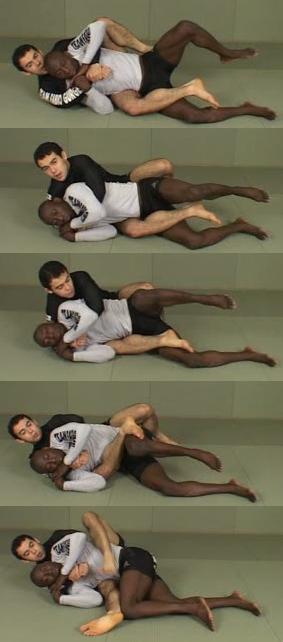
The running escape is effective against a different type of side control from the standard bridge and shrimp. Rather than gripping under your head and far arm, this time they are holding you with near side grips (i.e., an arm under your head and by the same side hip). That means that it is very difficult to bridge towards them and shrimp, because they've trapped that side. However, you can still bridge away from them, as that side is completely open.
A simplified version of the running escape starts in much the same way as an orthodox escape: bridge to make some initial space. Your aim is to create a gap so that you can turn on your side, getting your hand past their near shoulder. Use that hand as a block, step out with your bottom leg. Be careful you don't elbow your partner in the face as you do that, especially if you're pushing off their shoulder with your hand.
 You can either try and quickly turn from there, or walk your legs around towards their head. When you've walked far enough, turn to your knees by bringing your top leg over. That means you are now facing them. Braulio prefers to stay close, immediately bringing his arm up into their armpit. This is because they will often try to take your back as you turn. If as Braulio suggests you stick your arm up, you can then take their back instead. You could alternatively stay facing them on your knees, working from that position, or turn and drop into an open guard.
 After the class had drilled that version, I went into a bit more detail on the running escape. As you bridge, move your whole body, then drop back into a shrimp, curling into as tight a ball as possible. The defensive position you're looking to reach is turned away from them, with one leg over the other, foot based out. Your top elbow is clamped to that stepping leg, while your other hand goes behind your head for defence. This can be a handy place to catch your breath, although it can also be tempting to stall.
 I've been prone to doing that a lot in the past, but you need to move on to the actual escape. Push off the floor with your back foot, using that to move your body forward, your hips raised. Base on your head and shoulder, then turn your top knee inwards. Continue the rotation until you can recover open or half guard.
You need to keep five things in mind while in your defensive posture. First, don't let them sneak an arm around your waist. If they get an arm in, you aren't going to be able to turn away and free yourself. Should they get an arm inside, you'll have to either wriggle your elbow and knee back underneath, or shift to a different escape.
Second, be careful they don't take your back. This is the most common attack people have done to me when I've tried it. If they can lift you up enough to slide their bottom leg through, you're in trouble. If it does happen, stay tight and don't let them get that second hook in. Your elbow is already by your hip and knee to block the first hook, which means you can use the hand of that same arm to help protect your other hip from their second hook. You might also be able to move into turtle and roll them, but that needs good timing and control of their arm.
Third, watch for chokes. Saulo confidently states that they are never going to be able to choke you if you duck your head, bringing it next to your arm to block their entry. However, you can't just lie there and assume you're immune to being choked: you still need to take care they aren't able to set anything up.
Fourth, time your escape, staying sensitive to their weight distribution. If they are driving into you with lots of pressure, it will be hard to make space and turn. A good moment to attempt the escape is when they are looking to attack or transition to another position. Often, there will be a brief moment before they start when they take their weight off you. That is the time to spring the escape.
Finally, as you turn towards them, you need to make sure you secure the position. If you aren't careful, they can just keep moving round and put you back in side control. That's where I tend to get caught. If you're having trouble, you could instead try going to turtle, or perhaps use the principles of guard recovery: block their shoulder and bicep, get your legs in the way, hook their leg into half guard, etc.
It is possible that the person you are training with won't often use near side grips from side control. Speaking personally, I tend to go for the orthodox grip under the head and the far arm. That doesn't mean you can't use the running escape, it simply means you have to put yourself in position, forcing them to use near grips. All you need to do is make enough space that you can turn away and curl into a ball.
 As there were only five people there, I also decided to add in a third technique, which helps to drive home the principle. This is the same thing we did in the open guard recovery drilling, where to escape knee on belly, you push off their knee and kick over, swinging your legs around into open guard. There are a few more details on the actual escape, as you start by turning and establishing the running escape posture.
 To get rid of their knee, walk your legs round towards your head until you can knock their knee off your hip. You may want to nudge it with your elbow, but be careful, as if you leave a gap between your shin and arm, they may exploit it. Once their knee is off, you can then progress to the same running escape.
Interestingly, I noticed that in Jiu Jitsu University, Saulo finishes the running escape from side control with that same leg kick and swing into open guard. For that, remember you are pushing off one foot, then swinging the other to generate momentum. There is a danger they might either go for a double underhooks pass or fling your legs out the way to pass. So, clamp your feet down as soon as possible.