29 September 2011

29/09/2011 - Teaching (Escaping Side Control)

Teaching #022
Gracie Barra Bristol, (BJJ), Can Sönmez, Bristol, UK - 29/09/2011

As I've mentioned in the past, I've been working on developing a curriculum, based around six basic positions (side control, mount, closed guard, open guard, half guard and the back). Last week was the end of my first cycle, in terms of positions. I originally considered finishing up with two weeks of drills, which would recap what I'd taught over the previous eighteen weeks.

However, when I actually sat down to do that this week, I decided that it would either end up being far too much for one class, or I'd basically just end up rehashing one of the earlier lessons. So instead, particularly as I'm a bit pressed for time now the schedule for finishing the PhD is becoming clearer, I decided to just jump straight into my second cycle of eighteen lessons.

I want to largely follow the structure of my previous cycle, but I'm thinking about mixing up the positions up a bit. That's because I still want to create a natural progression from lesson to lesson. For example, escape mount with a trap and roll, which puts you in closed guard, then at the end of the closed guard series talk about passing, which leads into open guard, etc. The techniques I'll be showing this time are different, so I may need a different structure to keep that progression.

I'm going to start with side control again, as that's where I'm most comfortable. Also as I did before, I want to start with escapes. Last time I covered the basic options: I tried to have a reminder in the warm-up, by again including that continuous side control escape drill. The technique for tonight takes the same principle of bridging and turning, but in the other direction.

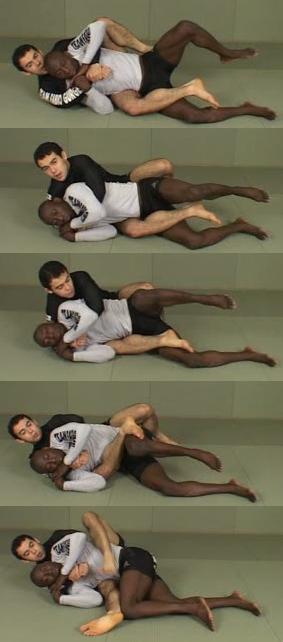
This is what I would refer to as the running escape, as I first saw it on Saulo's DVD: he touches on it briefly in that first series, then in much more detail on his follow up set. As always with BJJ terminology, there are plenty of other names for the same thing. For example, when I mentioned the running escape to Kev at RGA Bucks, he knew it as the 'coffee grinder' (Jean Jacques Machado's name for the running escape).

The running escape is effective against a different type of side control from the standard bridge and shrimp. Rather than gripping under your head and far arm, this time they are holding you with near side grips (i.e., an arm under your head and by the same side hip). That means that it is very difficult to bridge towards them and shrimp, because they've trapped that side. However, you can still bridge away from them, as that side is completely open.

A simplified version of the running escape starts in much the same way as an orthodox escape: bridge to make some initial space. Your aim is to create a gap so that you can turn on your side, getting your hand past their near shoulder. Use that hand as a block, step out with your bottom leg. Be careful you don't elbow your partner in the face as you do that, especially if you're pushing off their shoulder with your hand.

You can either try and quickly turn from there, or walk your legs around towards their head. When you've walked far enough, turn to your knees by bringing your top leg over. That means you are now facing them. Braulio prefers to stay close, immediately bringing his arm up into their armpit. This is because they will often try to take your back as you turn. If as Braulio suggests you stick your arm up, you can then take their back instead. You could alternatively stay facing them on your knees, working from that position, or turn and drop into an open guard.

After the class had drilled that version, I went into a bit more detail on the running escape. As you bridge, move your whole body, then drop back into a shrimp, curling into as tight a ball as possible. The defensive position you're looking to reach is turned away from them, with one leg over the other, foot based out. Your top elbow is clamped to that stepping leg, while your other hand goes behind your head for defence. This can be a handy place to catch your breath, although it can also be tempting to stall.

I've been prone to doing that a lot in the past, but you need to move on to the actual escape. Push off the floor with your back foot, using that to move your body forward, your hips raised. Base on your head and shoulder, then turn your top knee inwards. Continue the rotation until you can recover open or half guard.

You need to keep five things in mind while in your defensive posture. First, don't let them sneak an arm around your waist. If they get an arm in, you aren't going to be able to turn away and free yourself. Should they get an arm inside, you'll have to either wriggle your elbow and knee back underneath, or shift to a different escape.

Second, be careful they don't take your back. This is the most common attack people have done to me when I've tried it. If they can lift you up enough to slide their bottom leg through, you're in trouble. If it does happen, stay tight and don't let them get that second hook in. Your elbow is already by your hip and knee to block the first hook, which means you can use the hand of that same arm to help protect your other hip from their second hook. You might also be able to move into turtle and roll them, but that needs good timing and control of their arm.

Third, watch for chokes. Saulo confidently states that they are never going to be able to choke you if you duck your head, bringing it next to your arm to block their entry. However, you can't just lie there and assume you're immune to being choked: you still need to take care they aren't able to set anything up.

Fourth, time your escape, staying sensitive to their weight distribution. If they are driving into you with lots of pressure, it will be hard to make space and turn. A good moment to attempt the escape is when they are looking to attack or transition to another position. Often, there will be a brief moment before they start when they take their weight off you. That is the time to spring the escape.

Finally, as you turn towards them, you need to make sure you secure the position. If you aren't careful, they can just keep moving round and put you back in side control. That's where I tend to get caught. If you're having trouble, you could instead try going to turtle, or perhaps use the principles of guard recovery: block their shoulder and bicep, get your legs in the way, hook their leg into half guard, etc.

It is possible that the person you are training with won't often use near side grips from side control. Speaking personally, I tend to go for the orthodox grip under the head and the far arm. That doesn't mean you can't use the running escape, it simply means you have to put yourself in position, forcing them to use near grips. All you need to do is make enough space that you can turn away and curl into a ball.

As there were only five people there, I also decided to add in a third technique, which helps to drive home the principle. This is the same thing we did in the open guard recovery drilling, where to escape knee on belly, you push off their knee and kick over, swinging your legs around into open guard. There are a few more details on the actual escape, as you start by turning and establishing the running escape posture.

To get rid of their knee, walk your legs round towards your head until you can knock their knee off your hip. You may want to nudge it with your elbow, but be careful, as if you leave a gap between your shin and arm, they may exploit it. Once their knee is off, you can then progress to the same running escape.

Interestingly, I noticed that in Jiu Jitsu University, Saulo finishes the running escape from side control with that same leg kick and swing into open guard. For that, remember you are pushing off one foot, then swinging the other to generate momentum. There is a danger they might either go for a double underhooks pass or fling your legs out the way to pass. So, clamp your feet down as soon as possible.

28 September 2011

28/09/2011 - Gracie Barra Technique (Armbar Escapes)

Class #419
Gracie Barra Bristol, (BJJ), Nicolai 'Geeza' Holt, Bristol, UK - 28/09/2011

After the excitement of getting my gf along to a lesson followed by the ADCC, it was back to normal tonight. Geeza has been running through armbars this week, specifically armbar escapes. Before he got on to tonight's escape, he first had us drill two basic armbar set-ups. Kicking off with the armbar from mount, you're imagining your opponent shoves their arms into your chest (unlikely in sparring, but useful for the purposes of drilling). Put one arm on the outside of theirs, with your hand on their sternum. Put your other arm inside, so that the second hand goes on top of the first.

Slide your far leg up into their armpit, sole of the foot pointing towards their head. The near leg shifts to their shoulder. Lean forwards, then slide your shoulder leg over their. Your arm should already be over theirs: lock it over the back of their elbow. Geeza noted that drilling, that was safer than grabbing the wrist. In sparring, you would use your other arm to secure the wrist. Drop back, then repeat on the other side.

That was followed by a similarly basic armbar from knee on belly drill. They have put their outside hand on your knee, leaving a gap. Reach through the gap and pull them onto their side. Move around to step over their head, then drop back for the armbar.

The main techniques of the lesson were armbar escapes. Geeza called the first one a 'clear and bridge' escape. They are about to armbar you from mount, but you've managed to link your hands together to get a brief moment before you're forced to tap. Fling your arms over your head to knock their leg off your head. Bridge, then wriggle your head and shoulders over their leg. Make a tight turn to come up in their guard, making sure your elbows are safe: if you're not careful, they could go straight for an armbar or triangle.

Geeza followed up with another armbar escape, this time referred to as the 'ninja star' escape. They are again looking to secure an armbar, now from guard. To give yourself some time, drop your weight down in what Geeza dubbed the 'floppy dog' position, sunk towards your knees. You're then going to flick your hand to one side, so that your thumb is pointing at their shoulder (as if you're an '80s ninja throwing the aforementioned shuriken).

That should give you the space to quickly tug your arm free. Apparently, Matt Serra used the same escape in his classic upset with GSP, but from a mounted armbar. It is a little like the hitchhiker escape, except that you're not following the arm around. Instead, you're just trying to create the space to pull the arm out.

There was enough time for a round of free sparring, where I went with Oli. Tends to always be quite fun, as Oli often tries out random stuff and keeps things light and friendly. I was reminded again that I need to adjust my passing depending on their grips, as I wasn't properly dealing with the leg pressing into my bicep. Need to remember to move back to clear that off my arm.

I also had a chance to move into the running escape, which I wanted to practice as I'm teaching it tomorrow. The usual problems were raised again, which is to be very careful of their arm coming through by your hip. Interestingly, Oli was bringing the arm by the head through sometimes, which doesn't normally happen. I guess you can block that with your hands, but it is a bit different to them driving through the hip arm.

Finally, I tried putting into practice a handy suggestion from Donal on spider guard, which he mentioned at the start of the lesson. In short, when you're using the leg lasso, kick a bit further and hook the foot around their back. I haven't done that in the past because I worry about foot locks, but Donal said that's never happened to him. As Donal mentioned it was a tip from Michael Langhi, I'm happy to take his word for it: something to play around with, and it does provide more control. Donal is going to be teaching on Tuesdays starting next week, so I'm looking forward to checking out his lesson. :)

26 September 2011

Article - ADCC 2011

Article #22, by Can Sönmez

[My pics are crap, as they're from way up in the arena. For decent pics, check out Seymour's blog. His pics of all the British fighters here.
]

The Abu Dhabi Combat Club Submission Fighting World Championship, commonly referred to more simply as the ADCC, is the most prestigious nogi grappling competition in the world. It's backed by the financial muscle of Sheikh Tahnoun Bin Zayed Al-Nahyan, who aside from being a black belt under Renzo also happens to be incredibly wealthy. That has proved to be extremely fortuitous for grappling, as it means that since 1998, athletes have the chance to actually get some monetary reward for displaying their talents.

I haven't been to a live sporting event for many years: I think the last time was either Beşiktas or Turkey playing at İnönü, back when I used to go to football games in Istanbul with my father. However, when what is effectively the World Cup of grappling landed a train's ride north of me in Nottingham, there was no way I was going to miss it. Binoculars packed, I left my house in Bristol at 6:30am on Saturday: something has to be very special to get me up that early! ;)

There have already been numerous excellent write-ups of all the matches (like this), so I can be subjective. As usual, I was more interested in the women's fights than the men's. Unfortunately, there are currently only two female weight categories at the ADCC, which results in some ridiculous discrepancies. It isn't Gabi Garcia's fault she is so much bigger than everybody else, but she is competing with people literally half her size. It is a huge shame that Cris Cyborg had to pull out (I'm told due to the usual Zuffa shenanigans, but that may be hearsay: after all, other Zuffa employees were in the competition), as that would have been a fascinating match-up.

Still, I was looking forward to Garcia versus reigning champ Hannette Staack, who put up a fight, but couldn't quite get underneath Garcia's base. There were a few moments when it looked as if she might be able to enter into a leg submission, but Garcia made good use of gravity. Refreshingly, there was plenty of support for the Alliance stand out, who was visibly emotional at gaining her first ADCC title. Garcia has worked hard on both her technique and her physique, so deserves a certain amount of credit.

It was great that plenty of British women took part, with grappling stalwarts like Dr Rosi Sexton, even if they didn't prove successful. Australian Laura Ng had sadly suffered a blood clot in her leg on the plane journey, which must have been devastating for her. Hopefully she'll be back in two years. Ng's absence meant that my RGA Bucks training partner, Yas Wilson, was called up as a very late replacement. Yas did well, considering she took the match on almost no notice. To go in against multiple time world champion Michelle Nicolini is a tall order for a well-prepared black belt, so to do so as a purple is especially impressive.

Nicolini was probably the most entertaining competitor among the women, with some excellent guardwork in a tense match with ADCC 2009 winner Luanna Alzuguir. Staack gave a dominant performance en route to the final, until she ran into Garcia. As there were several matches going on at once, I wasn't able to watch as many female bouts as I would have liked, but then I can just get the DVD. That has the huge advantage of commentary, which I find increases my enjoyment of BJJ competitions many times over.

Intriguingly, it seemed the seasoned competitors were tapping early to avoid injury. Or at least they did at first: things changed later on. If you were facing Rousimar 'Toquinho' Palhares, he didn't care if you tapped: your leg was coming home with him. His nickname means 'tree stump', because his huge muscles are packed into a 5'8" frame. He's looks like a supervillain: apparently, the man even lived under a bridge back in the day!

After getting their knees mashed by Toquinho, David Avellan and Rafael Lovato were both left to limp off the mat (though Lovato bravely limped right back to face Popovitch for the bronze medal). It took Andre Galvao to finally slay the monster, narrowly escaping the knockout punch of Toquinho's leg attacks. Though his sportsmanship may be questionable, there is no doubt that when Rousimar Palhares is involved, you're in for an exhilarating match. Galvao had an incredible competition, winning not only his weight category, but taking the absolute title as well.

Among the male competitors, I mainly focused my binoculars on Dean Lister. I knew Lister (a black belt in BJJ under Jeffrey Higgs, who in turn is under Fábio Santos) had a decent record in MMA and had done well in the ADCC before (absolute champion in 2003, then he beat Jean Jacques Machado in the superfight at ADCC 2005), but I didn't realize just how skilled he was. Drawing on his experience, the 35 year old Lister submitted three out of his four opponents, which included the favourite, Rodolfo Vieira. That did mean I missed the Vinny Magalhaes armbar defence over on the other mat, which was getting a huge cheer, but Lister's technical mastery was worth it.

Aside from the high level BJJ on offer, I was also excited at the prospect of catching up with friends, both old and new. After heading up on the train from Bristol, I met up with Geeza outside of the arena, then swiftly got to wandering round the rest of the crowd. That meant bumping into old friends like Zaf, Ciaran, Seymour, Callum, Kirsty from Roy Dean UK, Eamonn, the RGA Bucks crew and various others. I love the way that it seemed almost all of UK BJJ turned out for this event. :D

On the new friends front, I enjoyed learning more about sports science with William Wayland: check out his blog here. While heading outside just before the Renzo superfight, I recognised the author of the she beast blog. Slightly embarrassingly, I got her attention by shouting out 'she beast!', then introduced myself as slideyfoot. Mainly because I forgot her real name was Hannah and my name (Can) tends to confuse people. ;)

When I heard the ADCC was going to be in the UK and Caleb would be commentating, I had high hopes that he'd be able to sort out another breakfast with the family. That's something the Fightworks Podcast has been doing before big events for a while. Despite being super-busy, Caleb delivered, making time to meet up with members of the Mighty 600,000 on Sunday morning.

I was surprised the turn-out was pretty weeny, though then again, a lot of people went out for drinks the night before. That left me, J-Sho, Caleb and Shawn Williams to chat about BJJ, later joined by a pair of cool Scots. Every time I meet somebody from Glasgow, I ask about one of my favourite bands of all time, Strawberry Switchblade. Not only had she heard of them, she'd even been to their gigs! Awesome. :D

I'm eager to check out all the coverage over the next few weeks. I'm sure Callum, J-Sho and Seymour will have something brilliant in the works for Jiu Jitsu Style. If somebody from the IBJJF is reading, please bring the Mundials to the UK too. ;p

< Previous Article :::

22 September 2011

22/09/2011 - Teaching (Attacking the Back)

Teaching #021
Gracie Barra Bristol, (BJJ), Can Sönmez, Bristol, UK - 22/09/2011

The rear naked choke (so-called because you don't need to grab any cloth: the Portuguese term is the more flowery 'mata leão', which means 'lion killer') is a high percentage attack from the back, and perhaps the signature submission in jiu jitsu. One of the great things about chokes is that they are so efficient: while somebody might be able to muscle their way out of a locked in armbar, a choke will work on everybody, no matter how big. The previous time I taught a RNC, it was for a non-BJJ audience, meaning I left out a lot of details. Suffice to say, this time round will be a bit more in-depth. :)

First, keep in mind those five points on maintaining the back I mentioned last week:


  • Establish your hooks inside their thighs, making sure you don't cross your feet

  • Bring one arm under their armpit, then the other over their shoulder

  • Follow them with your hips, so they have no space to escape

  • Press your chest into their upper back, for the same reason

  • Jam your head next to their skull, for better control and visibility


In terms of its basic mechanics, the rear naked choke is relatively simple. Repeating what I said last time, begin by bringing one arm around their neck, so that the point of your elbow is under their chin. You don't want to leave any space, as the idea is to press into both sides of their neck. This will close off their carotid arteries and prevent the flow of blood to the brain. That is an efficient and safe way of subduing an opponent.

You are then going to grip the bicep of your free arm. This is to lock the choke in place. Bring the hand of that bicep arm to the back of their head: I normally press the palm into their skull, but there are various options, coming down to personal preference. Back of the hand against their neck is arguably better, as that may slip in more securely than palm down.

Also, palm down is easier for them to grab, if they try to peel your fingers off their skull. Either way, when you're locking in the choke, don't reach your hand forward over their shoulder. If you do, then they can armbar you using their shoulder as a fulcrum. Instead, slide it behind the head.

Bring your head next to theirs on the bicep gripping side, to further cut off any space. If for some reason after grabbing your bicep you can't get your other hand behind their head, grab your own skull, using that grip to finish from there. Staying close to their back, expand your chest and squeeze your elbows together.

Despite the simplicity, it can be difficult to get the RNC choke. Everybody with more than a few lessons under their belt knows that you're going to be looking for that choke, so they will immediately be trying to create barriers with their arms and hands. Hence why I started the technical portion of the session by having everybody drill the basic mechanics, then went into further details on the RNC.

In order to clear a route to the neck, there are numerous options. First, you can adjust your hand positioning to maximise your efficiency. If you have one arm under their armpit and the other over the shoulder, then it can be helpful to grip palm to palm, with your shoulder arm on top. That means that as soon as there is any gap between the neck and chest, you can immediately slide your arm into their neck.

You can also try tricking them into giving you access to the hold you want. For example, when you try to get an arm around their neck, a common reaction on their part is to grab your arm and pull it down. If you respond by pulling up, they will pull down even harder. This means that if you time it right, you can suddenly switch direction, shoving their arms down right when they're pulling.

Even better, you can take their arm right out of commission. With one of your hands, grab their wrist. Shove it down towards their legs, then step over that arm with your same side leg. When you then re-establish your hook, they are left with only one arm to defend against both of yours. If they've grabbed your wrist, twist your palm outwards, shove it down and out, then again step over their arm with your leg. Either hook your foot inside their thigh, or around the outside of their hip. Whatever the grip, your goal is to maintain pressure, so they can't simply swim their arm free.

You can also just hold their wrist momentarily with your hand, although that does mean you are still going one arm against one arm, rather than the preferable two arms against one. Then again, if you have already trapped their arm on the neck-arm side, then you can use your hand under their armpit to hold their remaining arm. That would mean you now have one arm with which to attack, while they have no limbs left to defend themselves.

Once your arm is by their neck, secure it by gripping the back of their shoulder. Stephan Kesting has a useful video on RNC details, where he talks about holding the ridge of bone at the bottom of the shoulder blade, using what he calls a 'tiger palm'. From there, switch to gripping palm to palm over their shoulder, dropping the elbow of your back-arm down along their shoulder blade. That will further help to lock it in position: as Demian Maia demonstrates, you can even finish the choke from there. If not, you can then do what Kesting calls the 'creep', wriggling that elbow across their back to cinch up the choke.

If they are doing the escape I showed a a couple of weeks ago, they are going to fall in the direction your choking hand is pointing. To finish the choke, you'll need to either switch your arms or bring them back to the other side. For the latter, release your mat-side hook, push off the floor and roll them back to the other side (being careful to maintain control, as you're vulnerable to the escape). For the former, reach further to grab around their shoulder, then using that in combination with your hook, lift them up slightly. That should create the space to bring your armpit hand out and switch your arms.

Another problem is that people will also tend to tuck their chin. Some people advocate unpleasant methods to force your way through to the neck in that situation. For example, Kesting has a list here: the results of that kind of approach (though Kesting does make a point of saying he is not fond of pain-based options either) can be seen in this video. That is not how I want my jiu jitsu to look.

My goal is smooth, technical, leverage-based jiu jitsu, causing as little pain to the other person as possible. As Saulo says in my favourite BJJ quote:

"You have to think that your partner, the guy that you're training [with], has to be your best friend. So, you don't want to hurt him, you don't want to try to open his guard with your elbow, make him feel really pain, because jiu jitsu is not about pain. You have to find the right spot to save your energy"

I strongly feel it is best to avoid hurting your training partners, for four additional reasons:

  • You're in class to learn, not to 'win' at all costs. Save the 'win' mentality for competition.

  • If you're always hurting the people you spar, eventually nobody will want to train with you, making it rather hard to improve.

  • Presuming you're in BJJ for the long-term, you're going to be spending a lot of time with your training partners. Therefore it would make sense to build a good relationship.

  • Even if you don't care about your classmates, everybody has a different pain threshold. So, the efficacy of pain-reliant techniques will vary from person to person. The efficacy of leverage does not: that's based on physics, not how tough somebody is.


There is a less nasty option you could try for opening up their chin, from Andre Galvao. If they really shove their chin down, this may not work, but it is worth a go. Twist your hand so that your thumb is pointing down, then as you slide the arm to their neck, twist the thumb back up to lift their chin.

If I find I have no option except something brutish (e.g., crushing their chin until they tap from pain or lift their head), my preference is to instead transition to a different attack, like an ezequiel, a bow and arrow choke or an armbar. In my opinion, if I get to the point where force and pain are the main routes to finishing a submission, then my set up was poorly executed.

Tonight, I covered the ezequiel choke from the back: I intend to take a look at some of the other submission alternatives in future lessons. The great thing about the ezequiel is that you don't need such a deep grip as with the RNC, therefore it is more likely to take them by surprise.

If you find that you aren't able to get your shoulder arm across their neck, then you can attack with the arm you have under their armpit instead. Slide the armpit hand up to their opposite shoulder, so that the edge of that hand is cutting into the side of their neck. Grab the sleeve cuff of your other arm, then bring the hand of that other arm to the other side of their neck. Chop down with a knife hand. This should block off the carotid artery on both sides of their neck, resulting in a submission. Instead of using your arms for the choke, like in a RNC, you are using a combination of your hands and the material of your gi sleeve.

Like the RNC, you can be sneaky about the set-up for your ezequiel. For example, while you have a typical harness grip, slip your armpit hand into the bottom of your shoulder arm sleeve: it should be possible to do this without them noticing if you're careful. At the right moment, you can then yank it up, moving into the choke. Worth noting that Maia suggests the power comes from pulling the with the armpit hand, rather than relying on pressure from knife handing with your shoulder arm.

As it was odd numbers, I was able to jump in during the specific sparring from back mount, which was fun. However, I should probably have warmed up or something first, as it didn't take long for my left side and right leg to both get massive cramp. I don't think it affected the roll (except that I couldn't hook properly with my right leg, so was mostly controlling with my arms and the one hook), but it still hurt the next morning. Good reminder to make sure I don't join in cold.

Naturally I made sure to ask my girlfriend what she thought about the class and BJJ in general afterwards. I'll be editing her response, and with her permission, sticking it up on the website. :)

I won't be training again this week, so hopefully I'll see some of you at the ADCC! If you're not going to be there in person, remember you can still watch it online, here.

21 September 2011

21/09/2011 - Gracie Barra Technique (Butterfly Guard)

Class #418
Gracie Barra Bristol, (BJJ), Nicolai 'Geeza' Holt, Bristol, UK - 21/09/2011

Due to the fact I've trained all over the country, I bump into old training partners on a semi-regular basis. Tonight it was Alex, who is the first guy I met from Gracie Barra Birmingham back when I first started training there. He has now moved to Bristol, though mentioned that the club he started up North - Lakes BJJ – is still going.

Geeza kicked off with the basic butterfly sweep (though Geeza refers to the position as seated guard). From closed guard, shrimp out, foot on their hip to make space, bringing the other knee through across their chest. This stops them from stacking you, meaning you have a chance to insert both butterfly hooks. You're also gripping their same side sleeve by the elbow, while your other hand shoots through for a deep underhook.

From there, lift with your foot on the underhook side, pulling the sleeve grip. Your other leg threads underneath the underhook side leg, as you continue to drive their weight through their knee. Bring them to the mat, then transition to scarf hold or side control.

Next, Geeza showed a counter, which moves into a butterfly pass. If they establish butterfly guard and are about to sweep, raise the knee on the non-underhooked side. Drive forward to put their back on the mat, putting your head next to theirs. On the elbow-gripped side, push your hand through for an underhook.

In combination with your head and shoulder pressure, that should give you good control of their upper body. Shove their underhook side knee to the mat, then slide your non-underhook side knee over towards the mat. When you have your knee over the top of their leg, switch your hand from their knee to their same side arm and pull up. Pass to scarf hold.

Continuing the flow, Geeza then demonstrated a counter to that pass, which becomes a deep half guard sweep. As soon as they try for the knee cut pass, grab their knee and shove it to one side. At the same time, swing your legs and dive underneath them. The aim is to get into deep half, with your inside arm holding their leg, your outside arm reaching past to grab behind them. Secure that with a grip on their belt.

Having got to deep half, move your hand from their leg to their ankle and bend it towards you. Kick up with your inside leg to initiate the sweep. During your roll to the top, maintain the grip on their belt. That will mean you've immobilised their other leg, so they can't close their guard. Therefore it should be easy to extricate your leg and establish side control.

Specific sparring from there emphasised something I already knew: my butterfly guard is rubbish. In terms of passing, I was making fundamental errors like raising both knees, which was asking to be swept. I need to make sure I always keep my hips heavy, and definitely don't raise the knee on the underhooked side. I also wasn't going for the technique we'd just learned, which is another basic mistake.

Underneath, I was looking to use Chiu's tips on positioning, but without much success. I'll have to go review my notes, as I think I forgot all the important parts. Also, Geeza reminded me that I need to keep my knee outside of his hips, or he can just squash my leg and move round to pass. As it seems to be such a weak position for me right now, I should start pulling butterfly guard (as I used to in the past, thanks to Kintanon's advice). I'm short with little legs, which I'm told is ideal for butterfly guard. Hopefully that will help me to eventually get the hang of it.

Tomorrow, my girlfriend is keeping her promise from my birthday to check out my class. Exciting stuff, although it does mean I've been even more extensive in my pre-lesson preparation. Probably a bit too much, but meh. ;)

20 September 2011

Gi Review - Tatami Estilo Classic

[Thanks to BJJHQ for sending me the gi. If you've not heard of them yet, they offer a different BJJ product every day. That one product is sold at a reduced price, but it's only available for 24 hours.]

Short Review: This new offering from UK brand Tatami Fightwear is relatively plain, comfortable to wear and a good fit if you're slender with long arms (or at least longer than mine, as per the picture on the left). There is contrast stitching, along with white side vents, belt loops and drawstring.

Its £85 price tag is more than I would normally pay, but Tatami's construction is high quality with plenty of reinforcement. I found the tape at the back of the neck a bit scratchy, though I think I'm probably over-sensitive as I also find that with most t-shirts. Buy from Tatami, BudoVideos (eventually: I don't see it there yet) and also keep an eye on BJJHQ. That will probably be the cheapest option, when it pops up on their site. Currently, you can only get the Estilo Classic in blue.

Full Review: I can remember several years ago when Tatami Fightwear had just started up: I think that would have been about 2008 or 2009. Since then, Tatami has managed significant growth, with a considerable range of gis on offer. Tatami sponsors lots of UK athletes, along with massive names like Terere and Robson Moura. They've also collaborated with BJJ bloggers, in particular Seymour from Meerkatsu, which resulted in the pin-up gi. I wasn't a fan of the pin-up design, but I was definitely a fan of Tatami's engagement with the local BJJ community. Today, they aren't just a UK company anymore, selling around Europe and also the US, through outlets like BudoVideos.

The Estilo range is among the 'premier' gis produced by Tatami Fightwear. Generally speaking, I find that the Tatami gi has too many patches and embroidery for my liking (which isn't saying much, as I find almost every gi has too many patches and embroidery). The Zero G, which I've reviewed previously, is a typical example: patches across both shoulders, on the back skirt and even down the sides of the trousers.

When BJJHQ asked me if I wanted to review a gi for them, I said I'd be happy to as long as it was plain. They suggested Tatami, so I expected that would probably mean the budget Tatami Nova gi: that's intended to be a simple, entry-level gi, retailing for £51. However, I was instead sent the Estilo Classic. Unlike the Nova, Tatami's Estilo range is closer to £90, generally with plenty of bling.

The Estilo Classic is a step away from that busy look, with almost no patches: there are just two small designs at the top of the trousers and the jacket lapel. In terms of embroidery, the Estilo logo appears on both arms and at the bottom of the trousers. 'Tatami Fightwear' is also embroidered across the back of the jacket. Finally, there is a branded strip of tape running down the inside of the jacket and the cuffs of the sleeves and trousers.

It is a well-made gi. I had a thorough look after I unwrapped the parcel, but struggled to find any loose threads. That was impressive, as almost every gi I've reviewed has at least a few, and speaks to the quality of Tatami's factory. As with other Tatami products, the Estilo Classic also comes in its own drawstring gi bag, which is a classy touch. According to the Tatami website, the jacket is made from a single piece of 500gsm pearl weave material, while the trousers are heavy 14oz canvas. It also apparently comes with the option to 'mix and match', which is a great feature, though I couldn't see a separate drop-down box for trouser size (but that might just be me being dim).

As regular readers will know, I'm somewhat extreme when it comes to gi plainness, so it won't surprise you to hear that the Estilo Classic was still a bit too bling for me. I would prefer just the Estilo logo on one arm and trouser leg, possibly the two small patches, but nothing else. However, they are all relatively understated, with the patches saying 'Tatami Fightwear', while a simple 'e' in a laurel wreath adorns the leg and arms.

I was pleased to see there wasn't any embroidery or patches on the shoulders, as that's something I especially dislike. Patches on the shoulders are difficult to remove, as they tend to be sewn under the collar. Then again, embroidery is much, much harder to remove, which is at least one advantage to patches. I'm not fond of the way the Estilo Classic has words across the upper back, but again, that is a personal niggle: I don't think embroidered text is a good look, but your taste may vary.

The Tatami Estilo Classic is currently only available in blue. I have never worn any gi other than white: hence why this gi was unlikely to ever get into my regular rotation, no matter how good it was. Obviously this isn't going to be a problem for most people. Also, it looks as if the shade of blue is IBJJF legal. I guess if I ever competed in an IBJJF event, it would be useful to have a blue gi. As far as I'm aware, Tatami are planning to offer other colours if the Estilo Classic proves popular.

You'll also notice there is plenty of white contrast stitching. The side vents on the jacket are white too, as are the two drawstring vents and the four belt loops on the trousers. As with the Zero G, the drawstring is a bungee rope cord rather than a flat cotton string. Drying time is fairly average, going from straight out of the washing machine to fully dry in about 40 hours. Not having washed a non-white gi before, I wasn't sure if the colour would run, but fortunately that wasn't an issue.

This is also the first time I've worn a gi with branded tape stitched along the inside. I was a little wary of that tape, as I know Seymour over at Meerkatsu has mentioned that this tape can be scratchy. My skin appears to be similarly sensitive, as I will generally cut off labels on the inside of t-shirts and the like. Otherwise that tickling sensation at the back of my neck swiftly starts to annoy me.

I found that the tape at the neck of the Estilo Classic was indeed slightly abrasive, but the tape did not cause discomfort anywhere else (I don't wear a t-shirt or rash guard under my gi, so the tape was in direct contact with my torso, neck, wrists and ankles). Also, I've still got the vestiges of sunburn on my back and neck, so the skin was probably even more sensitive than normal. Finally, people tell me that scratchiness diminishes over time: I didn't notice it during the open mat sparring on Sunday, so clearly it wasn't that much of a distraction.

In terms of shrinkage, I measured the trousers from top to bottom and the outside of the collar to the cuff. Before washing, the trousers were just over 99cm/39 inches. After the first 40 degree celsius wash, that went down to 98cm/38.5 inches. After a second wash, there was another drop to 96cm/37.5 inches. There is plenty of knee padding, another good touch, securely attached. The seams are also solid, given that they're triple-stitched, with loads of reinforcement in the crotch area as well.

The sleeve started out at 74cm/29 inches. After the first 40 degree celsius wash, it dropped to 72cm/28 and a bit inches, which is where it stayed after a second wash. Partly due to that lack of shrinkage, I found the sleeves were a bit long for me, as you can see in the picture at the top of this review. The sleeves are tapered, ranking third thinnest in my sleeve comparison. The jacket in general wasn't a bad fit, so looks like it would work well for somebody with a similarly slim build. The collar is made of rubber, but held its shape at 40 degrees. Still, I would recommend avoiding higher temperatures, as otherwise it is liable to warp.

If you like plain gis but still want a bit of style, then the Estilo Classic may be up your street. I think I'm unusual in my tastes, so the lack of patches and embroidery – by normal standards at least – should have wide appeal even among more conservative BJJers. Judging by my experience, there isn't a lot of shrinkage in the arms, so pick your size carefully.

The construction looks to be excellent quality, so I would expect that if you drop the £85 on this gi, it should last you a long time (though naturally I can't say that for certain without a longer test). Available to buy from Tatami, presumably BudoVideos in future and I suspect it will be up on BJJHQ.com at some point too: keep an eye on their site.

18 September 2011

18/09/2011 - Teaching (Open Mat)

Teaching #020
Gracie Barra Bristol, (BJJ), Can Sönmez, Bristol, UK - 18/09/2011

There are two reasons I'm very excited about next week. The first is of course the ADCC, coming to Nottingham here in the UK on the 24th and 25th September (if you're not in the UK, Budovideos are streaming it here). A group of us are heading up from Gracie Barra Bristol. Judging by the ticket sales, most of UK BJJ is turning out to see this: it will be cool to catch up with some old friends, and perhaps make some new ones. If anybody wants to say hi, I'll be the weedy guy with big sideburns wearing a Gracie Barra Bristol hoody, and/or an assortment of BJJ related t-shirts (that's me failing to smile and in need of a shave on the left).

The second reason, which for me will be even more exciting, is that I'm cashing in my 30th birthday present. That means my girlfriend will be attending my class on Thursday, along with a female friend of hers. I think there are several other women coming along too, so hopefully that could mean a significant jump in the female membership at GB Bristol (presuming I don't scare them all off). At best, it will at least mean I can ask my gf and her friend what they did and didn't like, so I can get an idea of how best to encourage more women to join. If you're a woman in Bristol who fancies trying out BJJ, then Thursday should be a good time to do it. :D

Geeza is off competing, meaning that Miles ran the class on Friday, while Oli and I had the Sunday covered. I ran through the usual warm-up, then started pairing people up for sparring. There were quite a few beginners there, with one group who I think were from UWE (though they've been before, as I recognised the faces from GB Bristol Facebook pics ), along with a couple of Steve's friends from Bristol Uni. They were all willing to roll, so I made sure to pair them up with blue belts, both to help them with advice and to keep sparring fairly calm.

I got the chance to get in a few rolls myself, which was nice. As I'm currently teaching back mount, I was looking to get to the back. That didn't happen during most of the rounds, but I did at least get to work my guard recovery, which is always useful. I think on my next closed guard teaching cycle I'll focus on armdrags, as that's something I want to get better at myself anyway. Then there's Roger's nifty way of getting to the back, which is slightly different to the orthodox armdrag.

On Sundays, it is split into an hour of gi sparring, then an hour of nogi. I never train nogi unless I'm forced to by circumstance (e.g., if that's the only day I can train in a week), but before I left, I asked if anybody wanted to hang around to do some more gi sparring. Fortunately for me, a few people did, meaning I could get in a bunch more sparring while the nogi session got underway on the far side of the mat.

Rolling with Luke is always good fun, because of the way he stays controlled:hat gives me a chance to work my game. So, I finally managed to get around to the back, stepping a leg over into technical mount while looking to pass the guard, then rolling him over my leg to secure the back. There wasn't much time left, but I was pleased that this time I remembered to first bring a hand through the armpit and grab their collar for control.

It can be difficult to practice back mount in sparring because it is normally a struggle to get there, so we'll see if there is any specific back mount sparring next week (aside from my lesson, of course: if it's odd numbers or enough for king of the hill, I'll get in more practice then).

For my last roll it was working on maintaining the guard again. I still need to come up with a better solution to them putting a knee up when I'm looking to work my spider guard. I did practice some sweeps for exactly that situation a while ago, but I keep forgetting what to do. Possibly something I can focus on for my open guard classes in a few months, as I haven't yet decided exactly which open guard sweeps I want to teach.

15 September 2011

15/09/2011 - Teaching (Maintaining the Back)

Teaching #019
Gracie Barra Bristol, (BJJ), Can Sönmez, Bristol, UK - 15/09/2011

The back is a great position to be in. There are lots of submissions, your opponent can't easily see what you're doing, and you'll also get four points in competition (once you've got your hooks in). The first thing to note is a basic safety point, which is don't cross your feet. If you cross your feet, then all your partner has to do is cross their feet over yours and bridge, footlocking you. Instead, you want to be hooking your insteps inside their legs.

Second, you want to get a good grip with your arms. The harness grip (as always, various other names, like over-under) is a solid option for both gi and nogi. Begin by getting an arm under their same side armpit, so they can't slide down (as otherwise they can go for the escape I taught last week). If they have a gi, you can help secure the position by grabbing their opposite collar. The other arm comes over their shoulder.

If you can't grab a collar, then link your hands together, using that to lock yourself in place. You could also grab under both arms grabbing a collar, which is a excellent way to hold them in place. However, that means both your arms are occupied: for attacks, you have more options if you keep one arm free, to go over the shoulder.

Your arm by the shoulder is the one you'll be looking to shift into their neck and/or grabbing a collar, where you can start working for a choke. Stephan Kesting advises that rather than linking hands, you can grab your own arm, which in turn means you are blocking the best grip your opponent wants to get. As ever, play around and see what you prefer.

Third, keep your chest pressed against their upper back. To escape, they need to create space, so don't let them have any: stay glued to their upper back. You also don't want them to put you flat on your back, like in the bridge escape we saw last week, as then they can start moving their hips. If you drop back, make sure you've moved to the side. However, your ideal position is getting them face down.

Fourth, follow them with your hips, similar as when you're in their guard. If you keep moving your hips to square back up whenever they try and shift away, that again stops them creating space.

Finally, you want to keep your head locked to theirs, providing additional control. It also helps you to see what they're doing. Otherwise, their head would be blocking your line of sight. Place your head next to theirs on the armpit hand side, as that way you're controlling both sides of their skull.

From here, you might find they manage to knock off one of your hooks, or perhaps you're struggling to establish that second hook. If that happens, in order to take the back fully, use the grip you have with your arms to put them on your side, towards your remaining hook. Come up a little on your elbow and pull your remaining hook up slightly. Bring that foot across their body to hook their other leg. You're looking to retain enough control that you can then reinsert your second hook, particularly if their reaction is to kick out that leg.

There are numerous other possibilities when you lose a hook. Andre Galvao shows a simple option for retaking the back, which works well as a drill. They manage to clear one of your hooks and start bringing their hips over. Press your chest into their shoulder and roll them on their side, in the direction they were escaping. Use the foot they've dislodged to post , raising yourself up enough that you can slide your dislodged knee high up their back. Sit back and roll them towards your remaining hook, onto their other side, then re-establish your second hook. You can keep doing that from side to side as a drill.

Back mount is a great position, but if you're about to lose it because they're slipping free, you can also try a basic method of shifting to mount. They've cleared one hook and have put their shoulders onto the mat. It might be tough regain your back mount from here, especially if they've moved over your leg or have it under their body. Instead, shift so that you can bring your remaining hook over their body. Clamp that heel to their far hip, making sure it is providing you with enough control that they can't simply shrug you off. Pull out your elbow for base, then turn and slide through into mount.

08 September 2011

08/09/2011 - Teaching (Escaping Back Mount)

Teaching #018
Gracie Barra Bristol, (BJJ), Can Sönmez, Bristol, UK - 08/09/2011

Last time I showed a couple of options for getting to the back, ready to then teach three weeks of back mount. For this first week, I decided to cover escapes, as that's where I'm most comfortable. I'm going to pause at this point for a terminological babble (see my glossary for more of that kind of thing), as 'back mount' is less definite than I thought it was. I discovered this when telling Geeza what I was teaching tonight: he makes a distinction between what he calls 'back grab' and 'back mount', which is something I haven't heard before. Either way, the former is what I'm going to be covering, where they are sat behind you with their hooks in.

'Back mount' may also be used as a term for when they've flattened you out on your front. You might also hear 'rear mount'. Given I'm pedantic and academic, I wanted to make sure I'm using the right term. Having a look around for sources, I see that Saulo just calls it 'the back' in Jiu Jitsu University. In the Gracie Barra Fundamentals DVD set, Marcio Feitosa also refers simply to 'the back', at least when going from the same position I'm teaching for the next three weeks. Similarly, John Danaher talks about 'the opponent's back' and 'your back' in his section on positions in BJJ: Theory & Technique.

Having said that, Geeza's term does appear in the IBJJF rules, where you can find the line "front mount, back mount and back grab." There is also a definition on there:

E-) THE BACK GRAB: Is when the athlete grabs his adversary’s back, taking hold of his neck and wrapping his legs around his opponent’s waist, with his heels leaning on the inner side of his opponent’s thighs, not allowing him to leave the position. 4 POINTS.


Unfortunately there isn't a definition for 'back mount'. That may mean that the terms are interchangeable, or that they just didn't think it required a specific definition for some reason. On good ol Wikipedia (not exactly reliable, but hey), it lends support to the interchangeable theory: "When utilizing the back mount, often known in Brazilian Jiu-Jitsu as the back grab." In the marketing spiel for this very spieled up advert, it says "Getting the back mount (aka. "back grab") position". Then there's the US Grappling rules, which seem to use 'back mount' in the same broad sense as I do:

Back Mount with Hooks in = 4 points
Back Mount knees on ground, opponent flat on stomach = 4 points (Additional 4 points are scored by putting the hooks in from this position)
Body triangle from the back = 4 points


None of which is very conclusive, but it's the kind of thing I enjoy researching. ;)

Whether you want to call it the back, back mount or back grab, in that position they are frequently going to begin by trying to attack your neck. Protecting your neck is therefore a priority. In order to choke you, they need to block off both sides of your neck. That will normally use either your gi (e.g., sliding choke), their gi (e.g., ezequiel choke), your arms (e.g., arm triangle) or their arms (e.g., rear naked choke). Therefore you have to be aware of all four of them: note their grips, if they're trying to pull their gi across, if they're attempting to thread an arm through yours, and most obviously, if they are attempting to drive their arm under your chin.

As with any escape, you need to stay tight. Keep your elbows in, using your hands to cover your neck. There are numerous schools of thought on just how to do that: clamping your hands to both sides of your neck (which I learned as the 'Shirley Temple' defence), crossing your hands over your neck, grabbing both your collars, and Saulo's method of just grabbing one collar, keeping the other hand free to block.

Saulo's back escape starts by putting a thumb inside your opposite collar, using your other hand to block their hands. You then do what Saulo calls a 'big scoop', shifting your upper body down and your hips forwards. Next, kick out one of your legs to clear their hook (you may also need to nudge it with your elbow), then drop your other elbow down past their other leg and turn. You need to be careful here that they can't re-establish their second hook: block it with your elbow and knee if they try.

If you're a bit late and they've already got an arm across your neck, fall towards the open side, as if you were reclining on a couch (if you fall the other way, you're helping them get the choke. You also want to turn your head towards their elbow to relieve pressure. Both Saulo and his brother Xande suggest that when you fall to the side, you want to be lying on their knee, as that will stop them moving around. From there, Xande adds the detail of turning your hips to clear their hook.

Step your leg over, using that as a base to shrimp out. Grab their other trouser leg, to prevent them from moving through to mount as you try to escape. Keep shrimping in order to clear their leg, aiming to re-establish guard. Make sure that you are still being careful of your neck, as that is always a danger from back mount. Kev has a useful memory aid he uses when teaching this escape, which is "head, shoulders, hips." In other words, get your head to the mat, then your shoulders, then clear their hips.

Another way to escape the back is by bridging, as taught to me by Kev (which incidentally is the same way Feitosa teaches it on Gracie Barra Fundamentals). Cross your hands under your jaw, pressing the back of each hand against your face, elbows in tight. This should both block attempts to press a forearm into your neck, while still enabling you to use your hands to intercept theirs.

Bridge up, then keep moving to the side until you've created a bit of pressure on their hook. Push it off with your same side hand and immediately move your hips over onto the floor (the difficult part here is knowing when to move your hand to the leg, as you don't want to give them access to your neck). You need to make sure that you keep your weight on their chest the whole time, gluing their upper body to the ground.

Gradually walk around with your feet, maintaining that pressure on their chest. With your other hand (this will be the same hand that released their hooking foot earlier), reach over and grab their opposite leg. This is to stop them turning into you. It should now be a simple matter to twist into side control. You can also try hooking around their head: the picture below is from a slightly different scenario, as Xande is escaping the turtle, but similar principles apply.

07 September 2011

07/09/2011 - More Q & A at Gracie Barra Bristol

Class #417
Gracie Barra Bristol, (BJJ), Nicolai 'Geeza' Holt, Bristol, UK - 07/09/2011

As on Monday, I was again in two minds about heading to training due to that annoying sun burn, but then a gi arrived this morning (at the moment, I'm dealing with four requests to do a review, so that should mean several other packages arriving in the next few weeks). I like to provide a fast turn-around on reviews, so that immediately meant I wanted to give the gi its first test run that night. Should have the first of those reviews up in a couple of weeks.

In his text message before class, Geeza said tonight was going to be sacrifice throws, where you drop back on one knee, roll back looking over the shoulder on that side, lift them with your other leg and pop up in mount. However, as people were having trouble with it, he stopped at just the one technique.

The advantage of being an experienced instructor like Geeza is that you can switch your lesson plan with relative ease. Instead of continuing with takedowns, he then changed the lesson into another Q & A session: in my class I'd find that much tougher, as I wouldn't be confident I could properly answer any question. The first query put forward was a good one from Donal, about the best option if you're passing and have trapped both their legs to the mat, but you're being blocked. This prompted a cool bit of principle based teaching from Geeza, on the topic of guard passing.

The first principle is that to block a pass, you want to push their head in the direction they want to pass. Demian Maia explores that same principle, which he calls 'head control theory', in his DVD set. However, while pushing their head to the passing side helps block off one route, it makes it easier for the person on top to pass to the other side: they are already being rotated in that direction. If they quickly switch, it is difficult for the person being passed to quickly adjust and push the head the other way.

In a related principle (which I remember Geeza telling me early on, after he had easily blocked my passing attempts last year during one of our first spars), you should also pass to their strongest grip, using the grip like a hinge. The reason is that if you pass to the other side, you are going to get stuck, because whatever limb is trapped in that strong grip will be left behind. Instead, if they have a solid spider guard on your right and are also grabbing your right foot, pass around that point.

There wasn't a chance to drill it, perhaps due to time constraints. After a question from Arnaud about leglock options (which are pretty limited until brown belt, so that was a relatively easy question), it was straight into twenty minutes of sparring. That started with specific sparring from guard, where I was with a white belt who had just come back from an injury.

That would explain why I had an unusually successful time on top. Normally, as regular readers will know, I would be telling you I need to stand up, I have to stop being so passive, my passing went nowhere. Not this time: I found that immediately going to grab an arm (especially when they gripped me on that side) then standing worked well. This is what I've been meaning to do, but one of the few times I've actually been able to pull it off. From there, I was able to get a deep single underhook, reach to grab their collar and drive through.

I was also finding that going the other way worked a few times too, stepping over their other leg and pushing through to pass half guard. That was made easier by the fact I still had control of their leg, which makes it tough for them to lock a half guard. To my surprise, I even got the pass when you step back, drive their legs to the mat and move around. So that was nice, even though there were various mitigating factors like injury, time off, experience difference etc. I'll take what I can get when it comes to passing. ;)

Due to grabbing the arms, and initiating successful passes that way, it also made my partner more wary and less likely to attack. On the downside, I was still tending to lean forward too much when standing due to holding on to the collar grip unnecessarily. My hold on the sleeve could also do with some work, as it wasn't as solid as it should have been. Not to mention that when I tried to do the same single underhook pass on my next partner (we had now moved on to free sparring), a blue belt, it didn't work anywhere near as well.

I was able to push through to half guard again by switching to the other side, but they pulled off a nicely time sweep just as I thought I was passing, putting me underneath. We then spent the majority of the roll in my open and closed guard, where as ever I was looking to break their posture, control the head, and keep my legs in play at all times.

My last roll was with that same white belt again. He's a good bit stronger than me, so as I was getting pretty tired by that point, I pulled up on the leg to pass, got to half guard, drove through to low mount with grapevines and then just stayed there the whole roll. I went for the ezequiel repeatedly, but I'm making the same mistake of raising up too high. That gives them to opportunity to get their other arm in the way and block my chopping hand from getting to the other side of the neck. I need to remember to stay low and tight, blocking that defensive hand from scuppering the submission attempt.

05 September 2011

05/09/2011 - Q & A at Gracie Barra Bristol

Class #416
Gracie Barra Bristol, (BJJ), Nicolai 'Geeza' Holt, Bristol, UK - 05/09/2011

As some of you may know, I write the team history articles for Jiu Jitsu Style magazine. So far, I've been running through the major teams in a vaguely chronological fashion. However, I'm soon going to get to a point where I'm not completely certain of the dates: it doesn't matter all that much which order I do them in, but it did make me wonder what the exact dates were. That's why I thought I'd start compiling a BJJ Team Index. That should help me work out which team to do next. Ideally, I'd also be able to indicate all the connections somehow (e.g., Alliance > Brasa > Atos), but I haven't worked out the best way to lay it out yet on a spreadsheet. If you can help with clarifying any of the info, or adding more teams, let me know. :)

I also managed to add that Facebook 'like' button at the bottom of each post in my blog, which I've been wondering how to do. There is a relatively simple tutorial here, which worked for me (though note that the initial version of the code will mean it only appears in individual posts: if you want it on the home page of your blog, like I've set it up, scroll further down into that guy's post, where he tells you how).

I managed to get myself sun-burned all across my back and shoulders during the Weymouth trip last week, mainly due to building sand castles and digging big holes in the beach (yes, I am five ;p). That meant I wasn't planning to go to BJJ tonight, as abrasive gi + sun burn tends to = lots of pain. However, in the text message Geeza sends out before every lesson, he said that tonight it was Q & A. I remember the last time he ran one of those, and it was awesome. Hence sun-burn or not, I wanted to be there.

Geeza kicked off by answering Guy's question about wristlocks. Geeza started by discussing wristlock defence. His central point was that in essence, it is quite easy. You just make a tight fist with your hand, which is almost impossible to wrist lock. You're still at risk if you're gripping a gi with your fist, as you will often have a few fingers extended in the course of making a grip. Hence why in terms of avoiding wristlocks, it is safer to grip really, really tight.

Geeza also showed some basic wristlock attacks, starting with side control. If they are swimming for underhook to begin their escape, that's a perfect moment to go for a wristlock. Immobilise their arm by grabbing the elbow and slipping your other hand over their bicep. You need to time it so that you can press your weight down on the back of their hand, before they can wriggle it into a safer position. From there, simply shift your weight so that you're driving into their knuckles and bending their hand towards their forearm.

You can also do several things from within a triangle, because the arm is isolated. That makes it vulnerable to a bent armlock (pull on the wrist to bring it to either side of your body), an armbar, or a wristlock. Geeza's wristlock involved pressing on the back of their hand with both thumbs and twisting it slightly. If anyone is interested in wristlocks for BJJ, I'd recommend checking out Roy Dean's Art of the Wristlock.

The second question for the opening hour of the question and answer session was how to get out of what I think Geeza called a side choke, which I'd refer to as an arm triangle. Begin by trapping their arm next to their head, using your own head to lock it in place. It is key that their arm is pressing into their neck: you're going to be using that to block off one side.

Bring your arm on the other side underneath their head: this is what will block off the other side. Link your hands together, moving to side control, pressing a knee into their back. Your other leg is out for base. From here, gradually sink down with your hips, squeezing your elbows together. That should eventually result in a choke.

To escape the arm triangle, roll towards the open side. Your aim is to make a little bit of space, so that you're no longer in immediate danger of being choke. From there, bridge and bring your trapped arm out and around their head, so that it is no longer pressing into your neck. Be careful though, as if you put an arm on the far side of their head, they can trap it and start moving for a north-south kimura.

Finally for the beginner class, Geeza answered a question from Arnaud about finishing off armbars from mount when they have their hands locked together. Geeza responded with a strategic method, which wears them out before breaking the grip. You are about the sink the armbar, but they have managed to lock their hands. Reach through to grab their belt, palm up.

With your other hand (nearest their legs), grab their trouser leg. Lean towards that leg, which will make them sit up. Let them come up slightly, then push down on neck with your leg. Keep doing it to soften them up, then eventually move your hand from their leg to under their wrist, and break their grip.

I had texted a question earlier, which Geeza told me he'd cover at the start of the advanced class. I needed to leave after that, so for the sparring that always opens the advanced classes, I did a bit of guard passage with one of the children (I was being wimpy due to my sunburn.) Given that I was rolling with a small child, I had a chance to practice my teaching, as I tried to coach him through a guard pass. I'm not sure if I've worked out the right balance between encouraging children and providing enough resistance for them to have a meaningful spar, but good to get a chance to build my experience doing that.

Onto my question. For the next three weeks, I'm going to be teaching back mount, in my usual maintaining, escaping and attacking pattern. As the attacking lesson is the one I'm most keen to get right (as I've arranged for my girlfriend and one of her female friends to attend that night), I wanted to ask a question about entries into the rear naked choke

I was specifically interested in a way of getting to the neck without being nasty. Geeza's 'nice' option was to use the gi instead. Rather than a typical rear naked choke, work the gi collar across their neck (easier than arm, as it is much thinner), then you can do a variation on the RNC where you pull on their gi with one hand, threading the other between their arm and head.

A less pleasant option is to make a fist with your index finger slightly raised, then rub that along where their jaw line starts, working it under their neck. This is particularly effective if you do it on both sides at the same time. I'm uncomfortable with the nastiness, as I'm a big believer in Saulo's mantra of "treating your training partner like your best friend", but if you're happy to use the jaw dig, it does work.